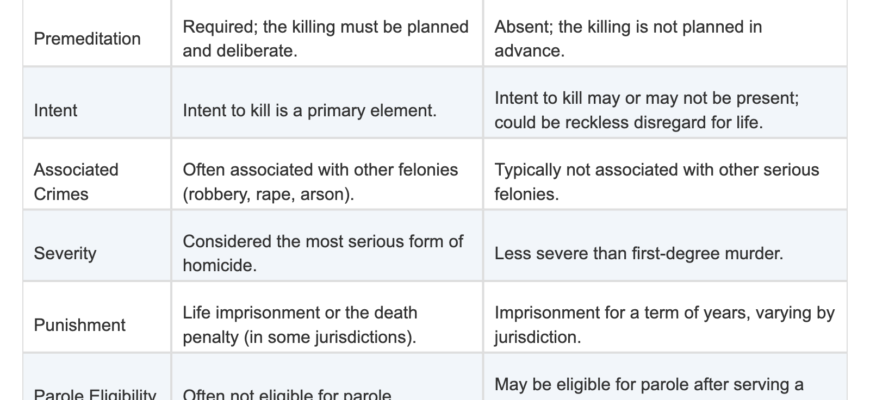
First-degree murder is premeditated and deliberate, while second-degree murder is intentional but not planned, or shows extreme reckless disregard for life.
First-degree murder
Premeditated and deliberate killing with intent. Also felony murder (killing during a serious felony such as arson, rape or robbery) in many states. Penalty: life in prison or death in some states.
Second-degree murder
An intentional killing that isn’t premeditated, or a killing with extreme indifference to human life. Penalty: often 15 years to life.
Manslaughter
Voluntary (heat of passion) or involuntary (reckless) killing, with lesser penalties.
Differences by state
Definitions vary, and some states have third-degree murder.
Proof
Prosecutors must prove intent and premeditation for first degree.

Example
Planning a poisoning is first degree. A fatal bar fight fueled by a sudden argument may be second degree.
Legal advice
Consult an attorney.
First-degree murder in detail
First-degree murder is a killing that is intentional and premeditated, meaning the person planned it or thought about it beforehand, even briefly in some states. Many states also classify a killing during a dangerous felony such as robbery, rape, arson or kidnapping as first-degree murder under the felony murder rule. Killing a police officer, using poison or torture, or lying in wait can also count. First-degree murder is punished most severely, often life in prison without parole and, in some states, the death penalty.
Second-degree murder in detail
Second-degree murder is an intentional killing that is not premeditated, or a killing caused by an act showing extreme indifference to human life, sometimes called “depraved heart.” Examples include a fight that escalates into a fatal stabbing, or firing a gun into a crowd. Penalties commonly range from 15 years to life, depending on the state.
Manslaughter
Manslaughter is a lesser offense where the killing lacks malice. Voluntary manslaughter involves a killing in the heat of passion after adequate provocation. Involuntary manslaughter involves a death caused by recklessness or criminal negligence, like a drunk driving crash. Sentences are generally shorter, such as 1 to 15 years.
Differences by state
Not all states use degrees of murder. About 35 states use degrees, and others such as New Jersey and Texas define murder differently, and the details of premeditation, felony murder and penalties vary. Some states have a third degree, as in Minnesota and Florida. Federal law uses first and second degree murder as well (18 U.S.C. 1111).
Proof
Prosecutors must prove beyond a reasonable doubt each element, including intent and, for first-degree, premeditation. Evidence may include planning, purchasing a weapon, threats, or the manner of killing. The defendant’s mental state is central.
Example
Someone who buys a weapon, waits outside a person’s home and shoots them could face first-degree murder. If two people argue and one grabs a nearby object and strikes a fatal blow without planning, second-degree is more likely.
Legal advice
This is general information, not legal advice. Anyone facing a homicide charge should contact a criminal defense lawyer, or a public defender if they cannot afford one.

Typical penalties and mental state
First-degree murder usually requires premeditation and deliberation, or a killing during certain felonies such as robbery, arson or kidnapping, under the felony murder rule. Penalties are the most severe and may include life in prison without parole, and in some states, the death penalty. Second-degree murder involves intentional killing without premeditation, or a death caused by extreme recklessness known as depraved heart. Sentences commonly range from about 15 years to life, depending on the state. Voluntary manslaughter involves a killing in the heat of passion after adequate provocation, and involuntary manslaughter involves a death from criminal negligence. Definitions differ by state, and some states use different degree names. For a specific case, consult a licensed attorney because the law and facts matter.
Based on data from the Cornell Legal Information Institute and the US Department of Justice