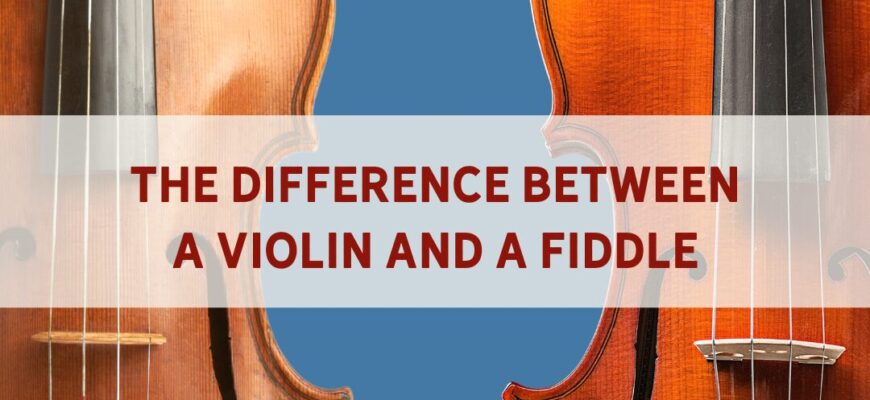
A violin and a fiddle are the same instrument. “Fiddle” is used for folk, country, and bluegrass, and “violin” for classical music.
Same instrument
A violin and a fiddle are the same instrument. The difference is in the style of music and playing technique.
Violin
Used in classical music. Players read sheet music, use vibrato and a classical bowing technique.
Fiddle
Used in folk, bluegrass, country, Celtic and old-time music. Played by ear with a more rhythmic style, often with a flatter bridge.
Setup differences
Fiddlers may use steel strings, a flatter bridge and different tuning (such as cross-tuning like AEAE).
Origins
“Fiddle” comes from Old English fithele. “Violin” from Italian violino.
Famous
Antonio Stradivari made violins in the 1600s to 1700s. Fiddlers include Alison Krauss and Mark O’Connor.

Tuning
Both: G-D-A-E.
Musical differences
Violin and fiddle are the same instrument. The difference is the style of music and the way it is played, not the construction.
Genres
- Violin: classical music, orchestras, chamber music and concertos.
- Fiddle: folk, bluegrass, country, Irish, Scottish, Cajun and Appalachian music.
Playing style

- Fiddlers often use short bow strokes, slides, double stops, drones and rhythmic bowing called shuffles.
- Classical violinists use vibrato, long phrasing and strict notation.
- Many fiddlers learn by ear, while violinists often learn from written music, though both can do either.
Setup choices
Fiddlers sometimes use a flatter bridge to make playing double and triple stops easier, steel strings instead of gut and a chin rest or none. Classical players tend to use a more curved bridge for individual strings.
Sizes
Violins come in sizes from 1/16 to full (4/4), with the full size suited for most teens and adults, and a fitting depends on arm length.
Tuning
Standard tuning for both is G3, D4, A4 and E5 in perfect fifths. Fiddlers sometimes use alternate tunings such as “cross tuning” (AEAE) in old time music to produce drone effects.
Cost
Student violins start around 100 to 400 dollars, professional instruments can cost tens of thousands, and rare Stradivari violins have sold for millions of dollars.
Famous players
Classical: Itzhak Perlman, Joshua Bell, Hilary Hahn. Fiddle: Mark O’Connor, Alison Krauss, Natalie MacMaster.
Style, repertoire and equipment
Violins and fiddles are the same instrument, with four strings tuned to G, D, A and E, but the word fiddle is used for folk styles such as Irish, bluegrass, country, Cajun and Scottish music. Violin generally refers to classical music, where players use vibrato and long bowing and read from sheet music, whereas many fiddlers learn by ear and use short, rhythmic bow strokes with double stops and drone strings. Fiddlers may use alternate tunings, such as AEAE (cross tuning), and a flatter bridge for playing on multiple strings. The same instrument can be set up with steel strings or synthetic core strings.

Sizes and cost
Violins come in fractional sizes for children from 1/16 up to full size, which is about 14 inches (35.5 cm) for the body, and the choice depends on arm length. Student instruments in a rental or starter outfit cost about 100 to 500 USD, intermediate violins about 500 to 3,000 USD, and professional instruments can be tens of thousands. Antonio Stradivari’s violins from the 1700s, such as the “Messiah,” have sold for millions, with one 1721 Lady Blunt Strad selling for 15.9 million USD in 2011. Famous fiddlers include Mark O’Connor and Alison Krauss, and well known classical violinists include Itzhak Perlman and Hilary Hahn. A common joke says the difference is that you spill beer on a fiddle.
Based on data from the Library of Congress and Smithsonian music collections