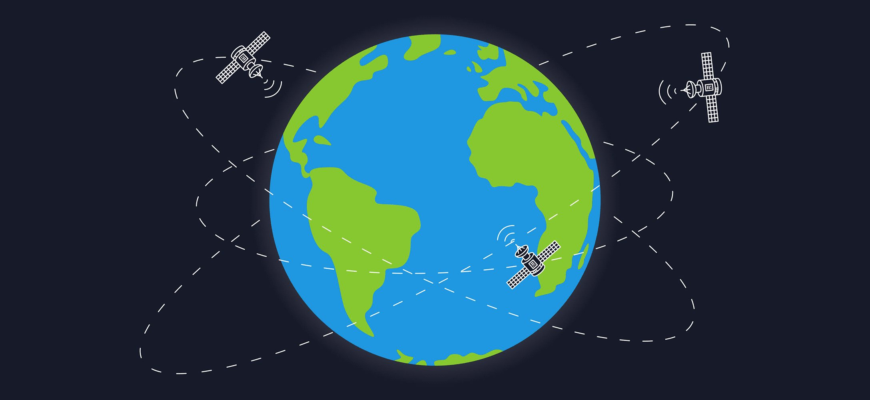
GPS works by satellites sending timing signals to your receiver, which measures its distance from at least four satellites to calculate your position.
How it works
GPS (Global Positioning System) is a US satellite navigation system with about 31 operating satellites orbiting at 20,200 km. Each satellite broadcasts its position and the exact time.
Position
A receiver measures the time signals take to arrive, converts to distance, and uses at least four satellites to calculate latitude, longitude, altitude and time (trilateration).
Accuracy
Smartphones are accurate to about 5 meters (16 ft) in the open. Dual-frequency devices can reach under a meter.
Atomic clocks
Satellites carry atomic clocks. Relativity corrections are needed (about 38 microseconds a day).
Other systems

Russia’s GLONASS, Europe’s Galileo and China’s BeiDou.
Free
GPS is free to use and operated by the US Space Force.
How GPS works
The Global Positioning System is a satellite navigation system owned by the US government and operated by the Space Force. A constellation of at least 24 operational satellites, now about 31, orbits about 20,200 kilometers above Earth in six orbital planes. They circle the planet twice a day. At least four satellites are visible from almost any point on Earth.
Position

Each satellite broadcasts its position and the exact time of the signal. A receiver measures the time the signal took to arrive. Since radio waves travel at the speed of light (about 300,000 kilometers per second), the delay gives the distance. With three distances, a receiver can find a position by trilateration. The fourth satellite is needed to correct the receiver’s clock error, giving latitude, longitude, altitude and time.
Accuracy
Standard consumer GPS in smartphones is accurate to about 4.9 meters (16 feet) under open sky, according to GPS.gov. Accuracy drops near tall buildings, in canyons, under trees and indoors. Augmented systems such as WAAS improve it to 1 to 2 meters, and survey grade RTK receivers reach centimeter accuracy.
Atomic clocks
Every GPS satellite carries atomic clocks (rubidium and cesium) accurate to a billionth of a second. A timing error of one microsecond causes a 300-meter position error. Relativity matters: satellite clocks run faster by about 38 microseconds per day from weaker gravity and slower from their speed, and the system corrects for both. Without correction, positions would drift by about 10 kilometers per day.
Other systems
Other satellite navigation systems include Russia’s GLONASS, Europe’s Galileo, China’s BeiDou, India’s NavIC and Japan’s QZSS. Most phones use several of them together. The generic term is GNSS (Global Navigation Satellite System).
Free
GPS is free to use worldwide, with no subscription, though phone data may be used for maps. The system began development in 1973, reached full operation in 1995, and was opened for civilian use. Selective availability, which degraded civilian accuracy, was turned off in 2000. GPS also provides timing for banking, power grids and cell towers.

Constellation and signal specifics
The GPS constellation has at least 24 operational satellites in medium Earth orbit at about 20,200 km altitude, completing two orbits per day, and currently about 31 are active. The system was developed by the US Department of Defense, with the first satellite launched in 1978 and full operation declared in 1995. Each satellite broadcasts a signal at 1575.42 MHz (L1), carrying timing and orbit data. A receiver measures the arrival times from at least four satellites to solve for latitude, longitude, altitude and clock error. Standard civilian accuracy is about 4.9 meters (16 ft) under open sky, according to GPS.gov, and is worse in cities with tall buildings and under tree cover. Relativity matters: satellite clocks run about 38 microseconds faster per day, and are corrected so errors do not grow by about 10 km daily.
Based on data from GPS.gov and NASA