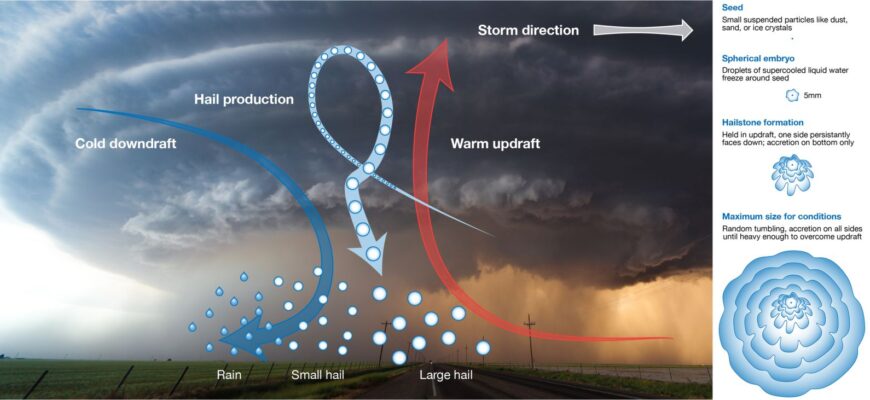
Hail forms when strong updrafts carry raindrops high into freezing parts of a storm cloud, where they gain layers of ice until too heavy to stay up.
Formation
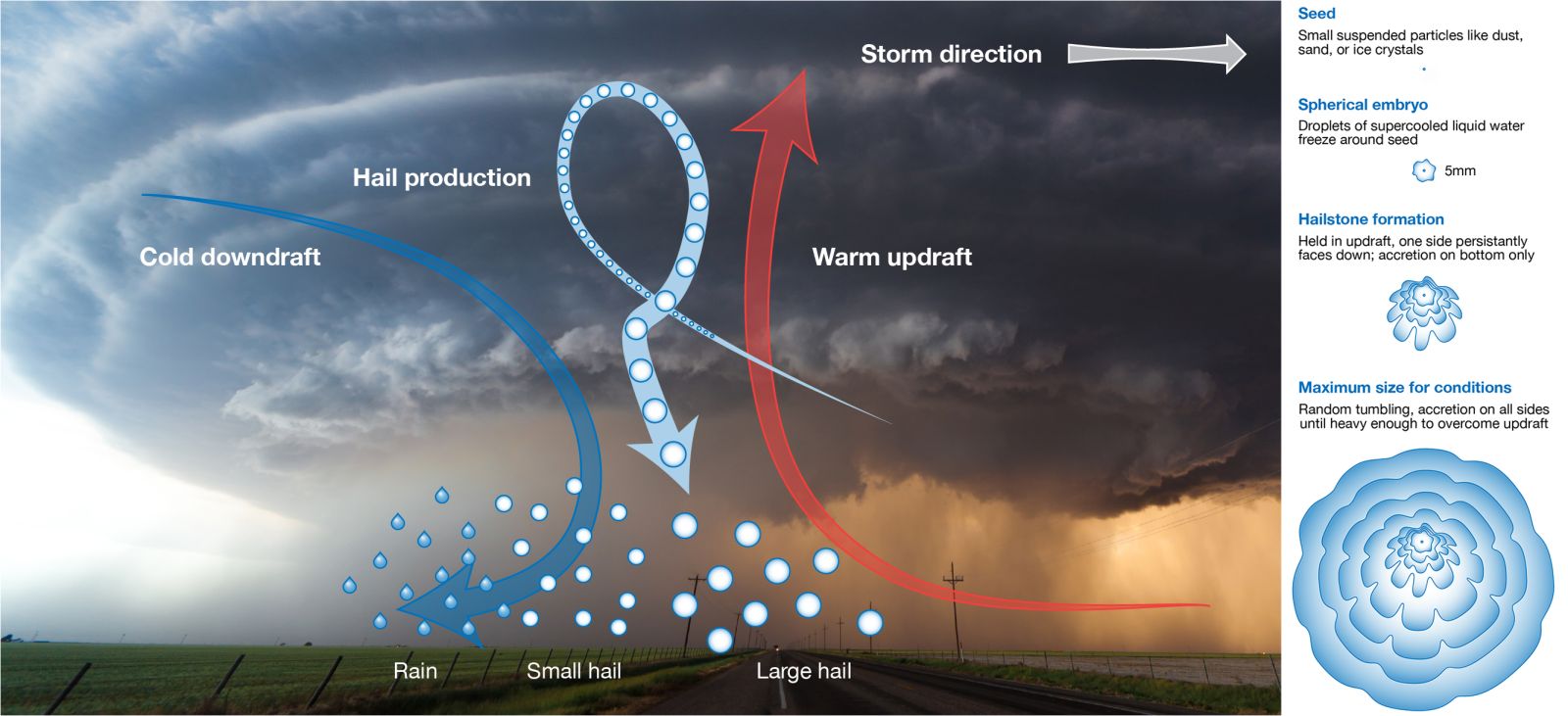
Hail forms in thunderstorms with strong updrafts. Raindrops get carried above the freezing level, where they freeze. As they fall and are lifted again, they gain layers of ice.
Size
When the hailstone becomes too heavy for the updraft, it falls. Stones larger than 1 inch (quarter size) are considered severe by the National Weather Service.
Record
The largest US hailstone fell in Vivian, South Dakota, on July 23, 2010: 8 inches in diameter and 1.94 pounds.
Damage
Hail causes about $10 billion of damage in the US each year (NOAA estimates).
Where
“Hail Alley” covers Colorado, Nebraska and Wyoming.
Safety
Seek shelter indoors and stay away from windows.
Hail vs sleet
Hail forms in thunderstorms. Sleet forms from rain freezing as it falls.
How hail forms
Hail forms in strong thunderstorms with powerful updrafts. Raindrops are lifted above the freezing level, where they freeze into small ice pellets. Supercooled water, which is liquid water below 0 C, freezes on contact and adds layers. The stone grows each time it is lifted by the updraft, until it becomes too heavy to be held up and falls. A cut hailstone shows rings like an onion, one for each trip through the cloud.
Size
Hail is measured by diameter. Pea size is 0.25 inch, a quarter 1 inch, golf ball 1.75 inches, baseball 2.75 inches and softball 4 inches. Severe hail by the National Weather Service definition is at least 1 inch across. Falling speed ranges from about 20 mph for small stones to over 100 mph for those the size of grapefruit, because larger stones fall faster.
Record hailstone
The largest hailstone recorded in the US fell in Vivian, South Dakota, on July 23, 2010. It was 8 inches in diameter, 18.62 inches in circumference and weighed 1.94 pounds. The heaviest hailstone ever recorded fell in Bangladesh in 1986 at about 2.25 pounds (1 kilogram), as reported.
Damage
Hail causes more than $10 billion in insured losses in the US each year, with years such as 2023 exceeding $14 billion, according to the Insurance Information Institute. It damages roofs, siding, windows, cars and crops. Large hail can injure and kill people and animals. A Moscow province storm in 1888 and an Indian one in 1888 were reported to have killed hundreds.
Where hail is common
“Hail Alley,” across eastern Colorado, Wyoming and Nebraska, gets the most hail in the US because cold air aloft meets warm moist air from the south. Texas has the most insured hail losses. Globally, hail is common in the Himalayan foothills, northern Italy, Argentina and parts of China.
Hail versus sleet
Sleet is rain that freezes while falling through a cold layer, forming small ice pellets, and occurs in winter. Hail forms in thunderstorms, usually in warm months, and is larger and lumpier.
Safety
- Move indoors or into a car. Stay away from windows and skylights.
- Park cars in a garage if you can.
- Do not go outside to collect hail while the storm is on.
- After the storm, check roof shingles, gutters and car paint, and contact insurers soon.
Hail physics in numbers
Hail forms in thunderstorm updrafts that carry water droplets above the freezing level, where they freeze and gather layers of ice. Updrafts of 50 mph or more are needed to hold stones aloft, and stones larger than about 1 inch require strong updrafts. The largest hailstone recorded in the US fell in Vivian, South Dakota, on July 23, 2010, with a diameter of 8 inches and weight of 1.94 pounds. Hail causes about 1 billion USD in crop and property damage per year in the US, and costlier years exceed 10 billion USD. The US hail belt of Nebraska, Colorado and Wyoming is called Hail Alley. Cars should be parked in a garage during hail warnings.
Based on data from NOAA and the National Weather Service