
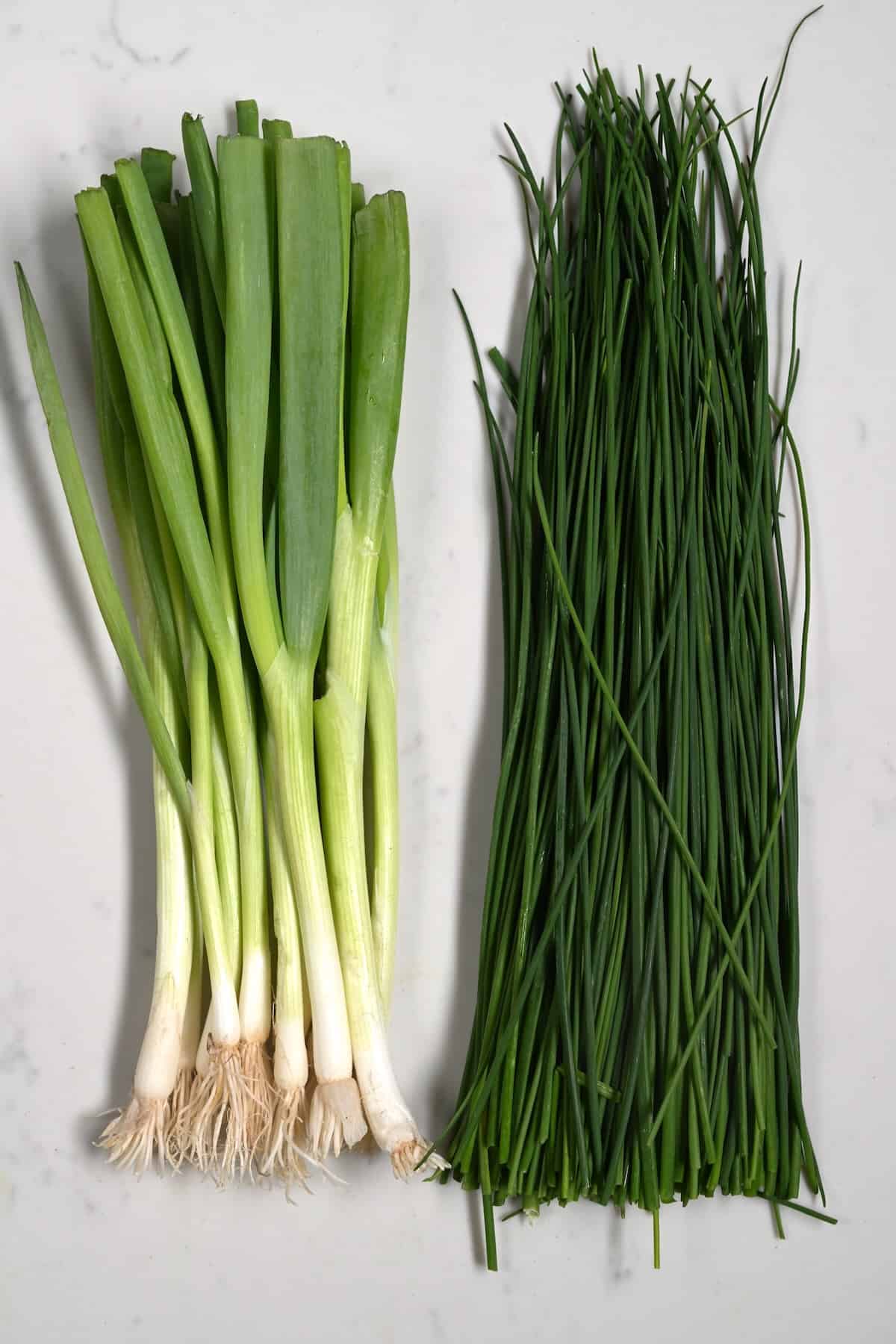
Chives are thin, hollow, mild herbs, while green onions have a white bulb and thicker stalks with a stronger onion flavor.
Chives
Thin, hollow, grass-like green herbs with a delicate onion flavor. Used raw, as garnish, since heat dulls them. Allium schoenoprasum.
Green onions (scallions)
Have a white bulb with thicker, flat green stalks and a stronger flavor. Both raw and cooked uses. Allium fistulosum.
Differences
- Size: green onions are larger.
- Flavor: chives milder.
- Bulb: scallions have a white base.
- Flowers: chives produce edible purple flowers.
Substitution
Use green onion tops in place of chives, but with a stronger taste.
Nutrition
Both are rich in vitamin K and low in calories.
Storage
Wrap in a damp paper towel in the fridge for 1 to 2 weeks.

Growing
Chives are perennial.
Appearance
Chives are thin, hollow, dark green stems, usually less than 1/4 inch thick, with no bulb. Green onions (scallions) have flat leaves, a white base and a mild bulb end.
Botany
Chives are Allium schoenoprasum. Scallions are Allium fistulosum or immature Allium cepa. Both belong to the onion family.
Flavor
Chives have a delicate onion and slightly garlic taste. Scallions have a more pronounced onion flavor, especially in the white part.

Cooking
- Add chives at the end of cooking or raw, as heat quickly destroys their flavor.
- Use scallions raw in salads or cooked in stir fries, soups and grilled dishes.
Substitution
Use green onion tops in place of chives, finely chopped, in a 1 to 1 ratio. You may want to use less to avoid a stronger taste.
Nutrition
Both are low in calories. A tablespoon of chives has about 1 calorie and provides vitamin K. Scallions provide vitamin K, vitamin C and folate. A half cup of chopped scallion has about 16 calories.
Flowers
Chives produce edible purple flowers in late spring, which can be used in salads.
Growing
Chives are perennial and come back each year. Scallions are usually grown as annuals, and the roots of store bought scallions can regrow in a glass of water.
Storage
Wrap in a damp paper towel in the fridge for up to a week, or freeze chopped chives for months.
Botany and taste
Chives (Allium schoenoprasum) are a perennial herb with thin, hollow, grass like leaves and a mild onion flavor, and they produce purple edible flowers. Green onions, also called scallions or spring onions, are typically immature plants of common bulb onions (Allium cepa) or related species, with white bulbs and long flat or hollow green tops. Green onions have a stronger, sharper flavor, especially in the white part, and can be cooked, while chives are usually added raw at the end of cooking, because heat dulls their flavor. Chives are rich in vitamin K, with 1 tablespoon providing about 6 micrograms, and contain small amounts of vitamin C and folate.
Substitution and growing
For a recipe calling for chives, the green tops of scallions, finely chopped, make an acceptable substitute, using a little less. Chives can replace scallion greens in garnishing, but they lack the white bulb. Chives grow back after cutting and thrive in pots on a sunny windowsill, and scallions can be regrown from the white roots placed in water. Store both wrapped in a damp paper towel in the fridge for about a week, and chives can be frozen after chopping. Scallions provide about 32 calories per 100 grams with 18.8 mg of vitamin C.
Based on data from the USDA FoodData Central and university extension programs







