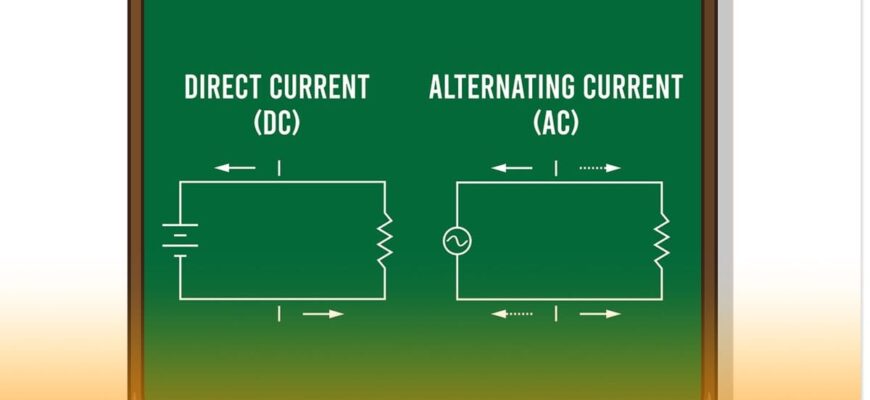
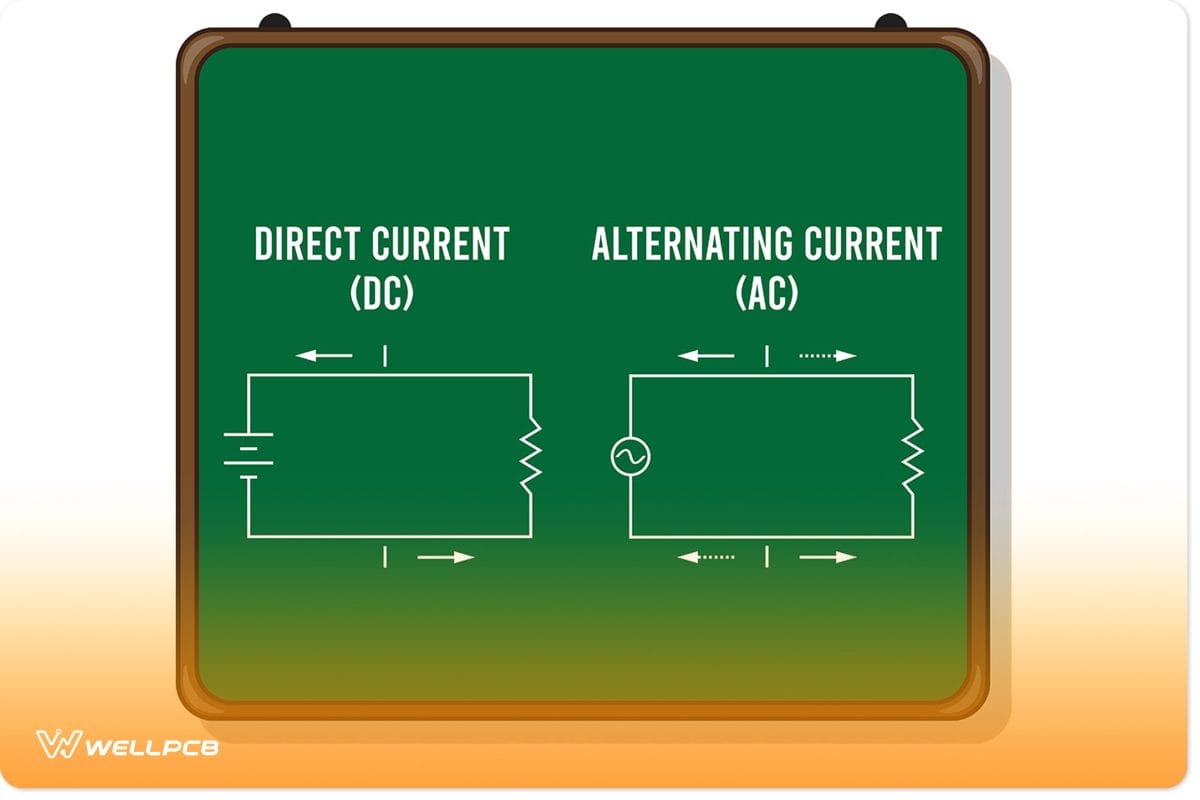
AC (alternating current) changes direction periodically, while DC (direct current) flows in one direction.
AC
Alternating current changes direction periodically (60 times per second in the US, 50 in Europe). It is used in homes and the power grid because transformers can step the voltage up and down, which allows efficient long-distance transmission.
DC
Direct current flows in one direction. Batteries, solar panels and electronics use DC.
History
Thomas Edison backed DC, while Nikola Tesla and George Westinghouse backed AC in the “War of the Currents” in the 1880s to 1890s.
Conversion
Adapters (rectifiers) convert AC to DC. Inverters convert DC to AC.
Voltage
US outlets supply 120 V AC.
Modern
High-voltage DC lines are used for very long distances.
AC in detail
Alternating current (AC) changes direction periodically. In the US, household power cycles 60 times a second (60 Hz) at 120 volts, and in Europe and most of the world it runs at 50 Hz and 230 volts. AC can be stepped up or down with transformers, so it is efficient to transmit over long distances at high voltage, which reduces energy lost as heat. The power grid uses AC.
DC in detail

Direct current (DC) flows in one direction at a constant voltage. Batteries, solar panels, fuel cells and USB ports supply DC. Electronics such as phones, computers and LEDs run on DC internally. Electric vehicles store energy in DC batteries.
History
In the late 1880s, the “War of the Currents” pitted Thomas Edison, who promoted DC, against George Westinghouse and Nikola Tesla, who promoted AC. AC won because it could be sent over long distances with transformers. The Niagara Falls power plant, which started delivering AC in 1895, helped settle the matter. High voltage DC (HVDC) now has a role in long lines of over 600 kilometers and undersea cables.
Conversion
- Rectifiers convert AC to DC. Phone chargers and laptop adapters contain rectifiers.
- Inverters convert DC to AC, as used in solar systems and for car power outlets.
- Transformers change AC voltage levels but do not work with DC.
Voltage
Voltage affects safety and equipment. The 120 volts of US outlets can be dangerous. Current through the body above about 10 milliamps can cause muscle contractions, and 100 milliamps across the chest can be lethal. AC can be more dangerous than DC at the same voltage because it can cause the muscles to lock on to a conductor.
Modern uses
Solar panels produce DC, which inverters change to AC for the home. Data centers and some buildings are moving to DC distribution to cut conversion losses. EV fast chargers deliver DC directly to the battery at 50 to 350 kilowatts or more. Microgrids and LED lighting favor DC.
Voltage, frequency and safety
In the US, household AC power is 120 volts at 60 hertz, while much of Europe and Asia uses 220 to 240 volts at 50 hertz. AC is easy to step up and down with transformers, so high voltage lines of 110 kV to 765 kV cut losses during long distance transmission. DC voltages are lower in everyday devices: a USB port is 5 volts, a car battery 12 volts, and an AA battery 1.5 volts. High voltage DC lines, which operate at up to about 1,100 kV in China, lose less power over very long distances and link grids with different frequencies. The “War of the Currents” in the late 1880s pitted Thomas Edison’s DC against George Westinghouse and Nikola Tesla’s AC. AC won for power grids. Solar panels and batteries produce DC, so an inverter is needed to convert to AC for the home.
Based on data from the US Department of Energy and the IEEE







