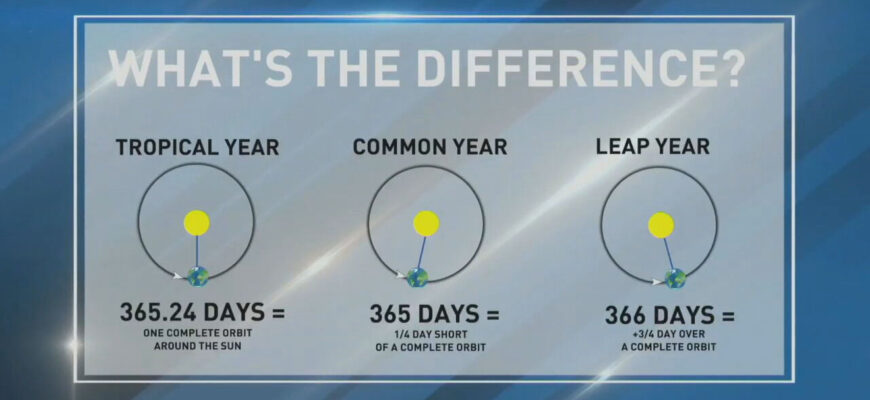
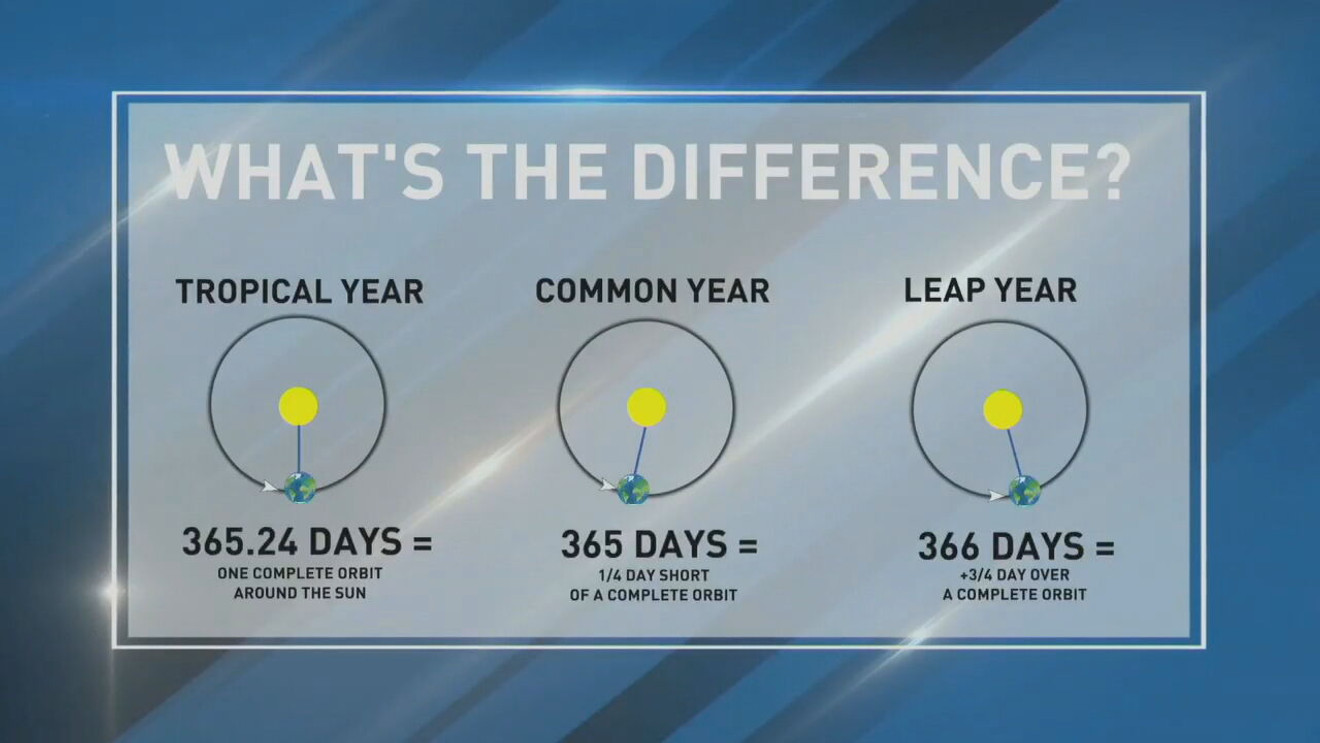
We have a leap year because Earth takes about 365.25 days to orbit the Sun. An extra day every four years keeps the calendar in line with the seasons.
Why
Earth takes about 365.2422 days to orbit the Sun. A calendar of 365 days would drift about 6 hours a year. An extra day, February 29, is added most years divisible by four.
Rules (Gregorian calendar)
- Every year divisible by 4 is a leap year.
- Except years divisible by 100.
- Unless also divisible by 400. So 2000 was a leap year, 1900 wasn’t, and 2100 won’t be.
History
Julius Caesar introduced the Julian calendar in 45 BC. Pope Gregory XIII reformed it in 1582.
Leaplings
People born on February 29 are called leaplings or leapers. About 5 million people worldwide.
Next leap years
2028, 2032, 2036.
Why
A calendar year is shorter than the time Earth takes to orbit the sun. Earth’s tropical year is about 365.2422 days, which is about 5 hours, 48 minutes and 46 seconds longer than 365 days. If the calendar did not add a day, it would lose about one day every four years, and the seasons would drift. After 100 years, the calendar would be off by around 24 days, and in about 700 years, summer would arrive in what the calendar calls winter.
Rules (Gregorian calendar)

- A year divisible by 4 is a leap year.
- Except years divisible by 100 are not leap years.
- Except years divisible by 400 are leap years.
So 2000 was a leap year, while 1900 and 2100 are not. This gives an average year length of 365.2425 days, close to the true value. The error is only one day in about 3,000 years.
History
In 46 BCE, Julius Caesar introduced the Julian calendar with a leap day every four years, assuming a 365.25-day year. This was slightly too long, and by 1582 the calendar had drifted about 10 days. Pope Gregory XIII issued the Gregorian calendar, skipping 10 days (October 4 was followed by October 15, 1582) and adding the century rule. Catholic countries adopted it at once. Britain and its colonies changed in 1752, skipping 11 days, and Russia in 1918. Greece changed in 1923.
Leaplings
People born on February 29 are called leaplings or leapers. About 5 million people worldwide have leap day birthdays, with a chance of about 1 in 1,461. In non-leap years they usually celebrate on February 28 or March 1. The town of Anthony, Texas, and Anthony, New Mexico, call themselves the “Leap Year Capital of the World.” In Ireland and Britain, tradition says women may propose marriage on leap day.
Next leap years
Recent and coming leap years: 2020, 2024, 2028, 2032, 2036 and 2040. Leap seconds, added occasionally to atomic time because Earth’s rotation is slightly irregular, are a separate matter. The international body decided to phase out leap seconds by 2035.

Astronomy numbers behind the calendar
Earth takes about 365.2422 days to orbit the Sun, so a 365 day calendar drifts by about 6 hours a year, or about one day every four years. Julius Caesar introduced the Julian calendar in 45 BC with a leap day every four years, which overcorrects slightly, since the average year was 365.25 days. By 1582, the calendar had drifted by about 10 days, and Pope Gregory XIII introduced the Gregorian calendar, skipping 10 days in October 1582. Under the Gregorian rule, years divisible by 4 are leap years, except century years not divisible by 400, so 1900 was not a leap year, but 2000 was. The average Gregorian year is 365.2425 days, off by about one day in 3,000 years. People born on February 29 are called leaplings or leapers, and there are about 5 million worldwide. The next leap years are 2028 and 2032.
Based on data from NASA and the US Naval Observatory