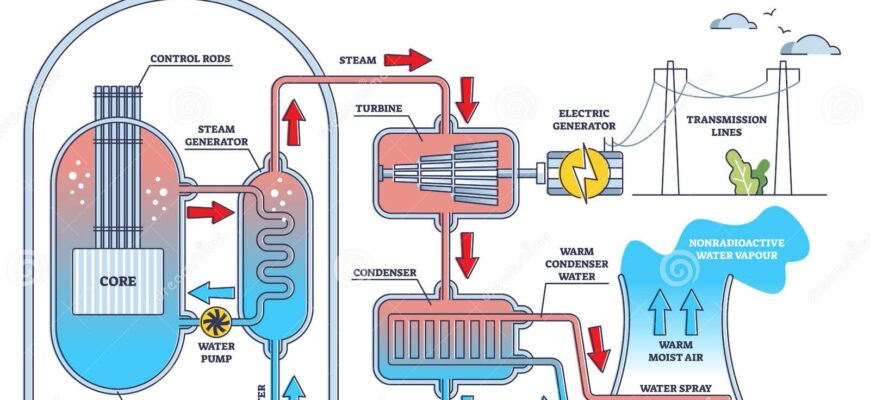
Nuclear power plants split uranium atoms (fission) to heat water into steam, which spins a turbine to generate electricity.
Fission
Nuclear power plants split atoms of uranium-235 (fission). The splitting releases heat.
Steps
- Fuel rods in the reactor core undergo a controlled chain reaction.
- The heat boils water, producing steam (or heats water in a pressurized loop).
- Steam spins a turbine connected to a generator.
- Steam condenses back to water in cooling towers.
Control
Control rods absorb neutrons to slow or stop the reaction.
Reactor types
Pressurized water reactors (PWR) and boiling water reactors (BWR) are common in the US.
Share
Nuclear provides about 19 percent of US electricity and 10 percent worldwide (EIA, IAEA).
Waste
Spent fuel is stored in pools and dry casks.
Emissions
No CO2 during operation.
Fuel
Most reactors use uranium dioxide pellets enriched to about 3% to 5% uranium-235, stacked in zirconium alloy tubes called fuel rods. Natural uranium has only 0.7% U-235, so enrichment is needed. A single fuel pellet the size of a fingertip holds about as much energy as 1 ton of coal or 149 gallons of oil, according to the Nuclear Energy Institute.
Energy conversion chain
- Fission heats water.
- Hot water or steam drives a turbine.
- The turbine spins a generator.
- Steam is condensed and returned to the reactor or steam generator.

A large reactor produces about 1,000 megawatts of electricity, enough for roughly 750,000 homes.
Pressurized and boiling water reactors
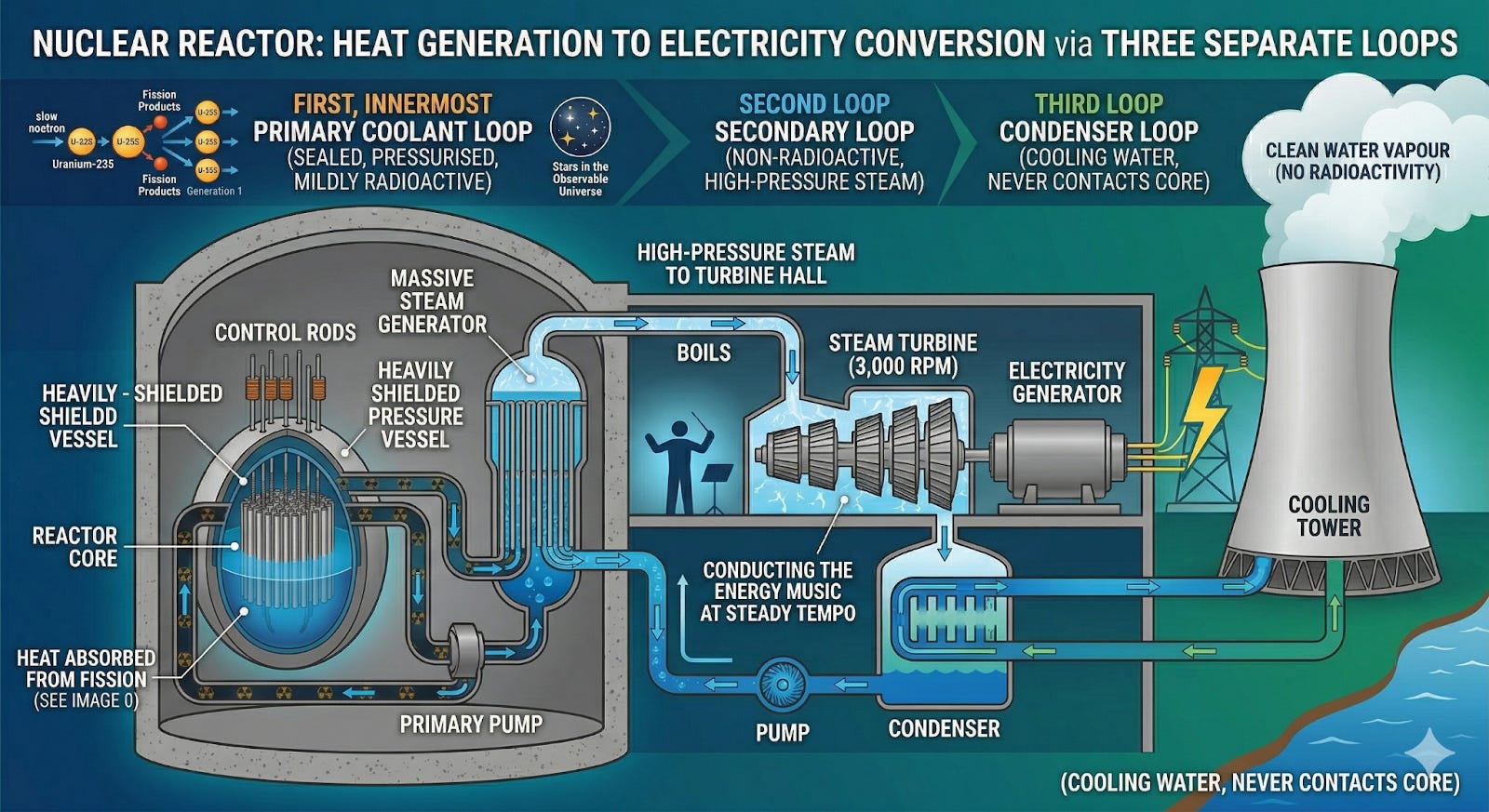
In a pressurized water reactor (PWR), water at about 155 bar stays liquid at around 315 degrees C and transfers heat to a separate loop that makes steam. In a boiling water reactor (BWR), water boils inside the reactor vessel and the steam goes directly to the turbine. PWRs make up about two thirds of reactors in the world.
Safety systems
- Multiple barriers: fuel pellets, fuel cladding, a steel pressure vessel and a concrete and steel containment building.
- Control rods stop the chain reaction within seconds.
- Emergency core cooling and backup power systems remove decay heat after shutdown.
Capacity factor
Nuclear plants in the US run at a capacity factor above 90%, higher than any other source, according to the Department of Energy.
Waste
A one gigawatt reactor produces about 20 to 30 tons of used fuel per year. All the used fuel produced by US commercial reactors in about 60 years would fit on one football field stacked less than 10 yards high. It is stored in cooling pools and then in dry casks.
Worldwide numbers
About 440 reactors operate in 32 countries and supply about 10% of the world’s electricity, according to the International Atomic Energy Agency.
Emissions and deaths
Lifecycle emissions are about 12 grams of CO2 equivalent per kilowatt hour, similar to wind. Studies of deaths per unit of energy put nuclear among the safest sources, including accidents.

Reactor fuel and operation
Nuclear plants use uranium fuel enriched to about 3 to 5 percent uranium-235, formed into ceramic pellets stacked in metal rods. In fission, a uranium atom splits when hit by a neutron, releasing heat and more neutrons that sustain a chain reaction controlled by control rods and coolant. The heat boils water into steam that spins a turbine connected to a generator. About 440 reactors operate in roughly 30 countries and supply about 10 percent of the world’s electricity, while the US has 94 reactors that provide about 18 percent of its electricity and nearly half of its carbon free power, according to the Department of Energy. US nuclear plants run at a capacity factor above 90 percent. Used fuel is stored in pools and dry casks at plant sites, since the US has no permanent repository, and lifecycle emissions are around 12 grams of CO2 per kilowatt hour, according to the IPCC.
Based on data from the US Department of Energy and the International Atomic Energy Agency