
End an essay by restating your thesis in new words, summing up your main points, and finishing with a closing thought.
Structure of a conclusion
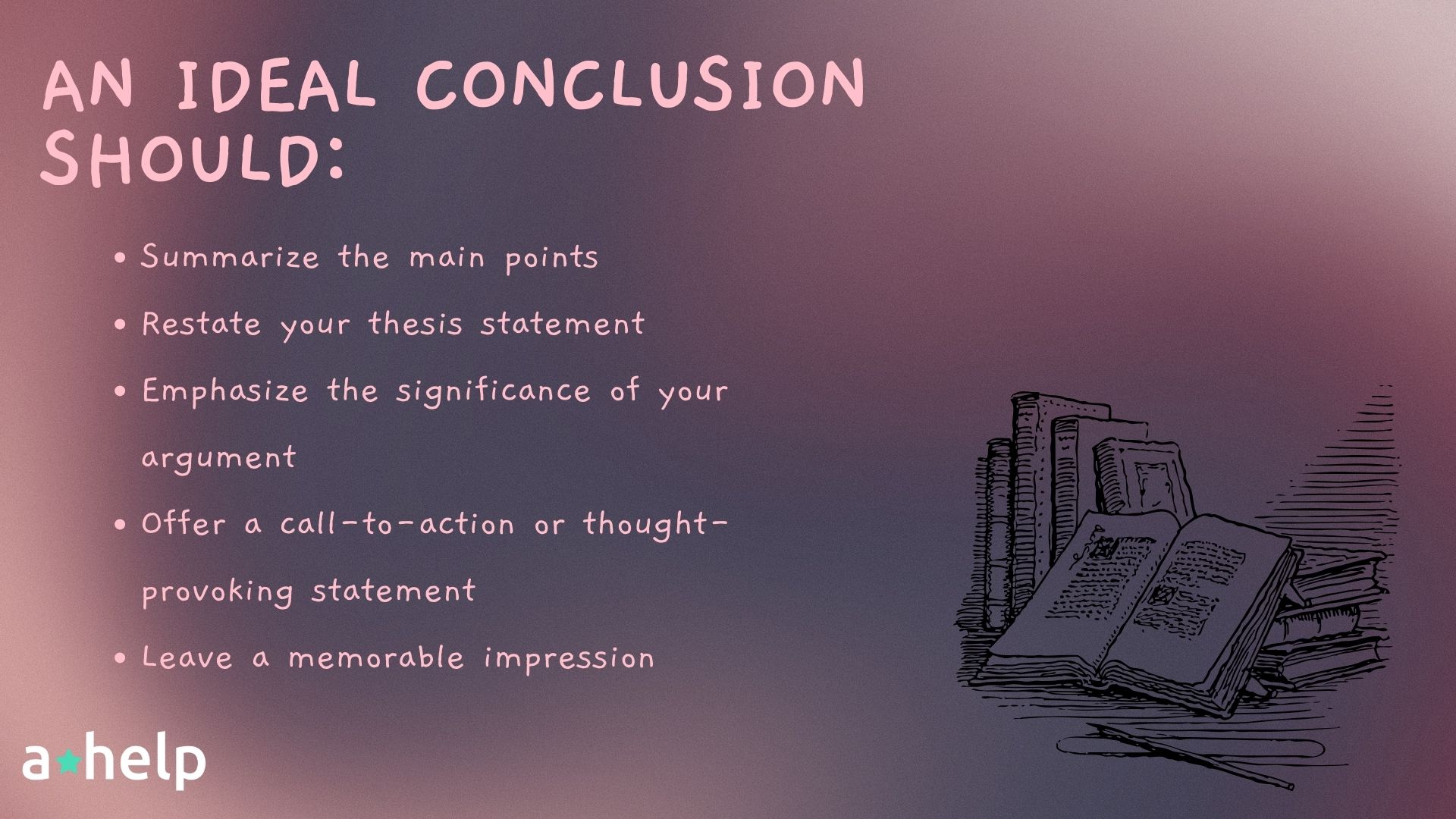
- Restate the thesis in new words.
- Summarize the main points briefly.
- Explain why it matters (the “so what”).
- End with a closing thought, call to action or question.
Length
Usually 5 to 10 percent of the essay. One paragraph in a five-paragraph essay.
Avoid
- Introducing new evidence.
- Starting with “In conclusion”.
- Apologizing.
- Copying the thesis word for word.
Example
“Taken together, these findings show that early education improves outcomes. The challenge now is to ensure every child has access.”
Tips
Read the introduction again, and link the end to the beginning.
Structure of a conclusion
A strong conclusion has three jobs: remind the reader of your main argument, show how the evidence fits together, and leave the reader with a sense of significance. A common structure is:
- Restate the thesis in fresh words, not copied from the introduction.
- Summarize the key supporting points in one to three sentences.
- Show why the argument matters, what it implies or how it connects to a larger idea.
- Close with a final thought, such as a call to action, a question to consider or a link back to the opening image or story.
Length
A conclusion typically makes up about 5% to 10% of an essay. For a five-paragraph essay it is a single paragraph of 4 to 6 sentences. A 2,000-word essay may have a conclusion of 150 to 200 words. College essays and research papers may need a conclusion of one or two paragraphs.
Avoid
- Introducing new evidence or major new arguments, which should be in the body.
- Starting with “In conclusion” or “To sum up”, which are weak and obvious.
- Apologizing or hedging, such as “I may not be an expert”.
- Repeating the introduction word for word.
- Overly broad statements like “Since the dawn of time”.
- Quotes without comment.
Example
Thesis: “Schools should start later in the morning to improve student health.”
Conclusion: “Teenagers’ bodies shift their sleep cycle later during puberty, and studies show later start times raise sleep by about an hour and reduce car crashes among teen drivers. Districts that moved start times, such as Seattle, saw gains in attendance and grades. Making this change is a simple policy decision that supports health and learning for millions of students.”
Tips
- Write your conclusion after you finish the body, so it reflects what you actually argued.
- Answer the “so what?” question.
- Match the tone of the essay.
- End on a strong, specific final sentence.
- Revise by reading the introduction and conclusion together to check they match.
- For a narrative essay, the conclusion can reflect on what you learned. For an analytical essay, it should synthesize the argument and not just summarize.
Step by step conclusion method
A strong essay conclusion restates the thesis in new words, summarizes the main points in one or two sentences and ends with the larger meaning. Most guides suggest a conclusion of about 5 to 10 percent of the essay, so roughly 3 to 5 sentences for a five paragraph essay and a full paragraph for longer papers. Do not add new evidence or new arguments, and avoid weak phrases like “in conclusion” or “to sum up,” which many instructors consider unnecessary. Avoid apologizing or hedging. Good endings connect back to the introduction, suggest next steps or ask a question worth thinking about. A common check is the “So what?” test: if the reader could ask it after the last line, the ending needs sharper significance. Read it aloud to catch awkward phrasing, and match the tone to the assignment.
Based on data from the Purdue Online Writing Lab and the Harvard College Writing Center







