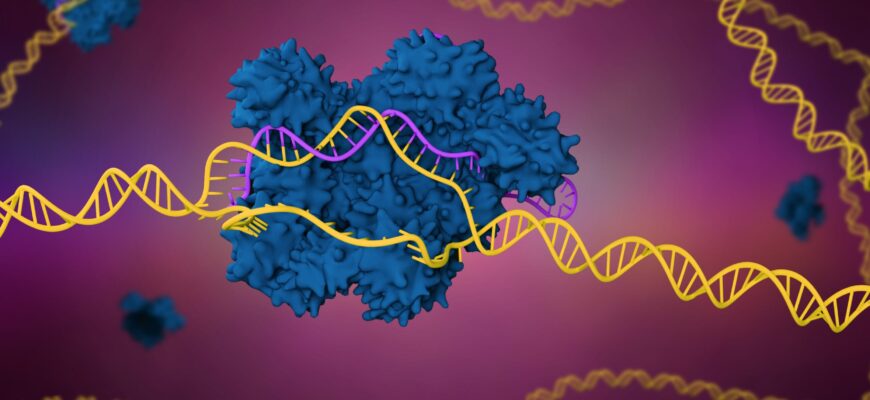
CRISPR-Cas9 uses a guide RNA to lead the Cas9 enzyme to a specific DNA sequence, where it cuts the DNA so the cell can delete or edit it.
What CRISPR-Cas9 is
CRISPR-Cas9 is a gene-editing tool adapted from a bacterial immune system. Jennifer Doudna and Emmanuelle Charpentier won the 2020 Nobel Prize in Chemistry for developing it.
How it works
- A guide RNA is designed to match a target DNA sequence.
- The guide RNA leads the Cas9 enzyme to the target.
- Cas9 cuts both strands of DNA at that spot.
- The cell repairs the cut: it may disable the gene or insert new DNA from a template.
Uses
Research, crops, and therapies. In December 2023, the FDA approved Casgevy, the first CRISPR therapy, for sickle cell disease.
Risks

Off-target cuts and ethical debates about editing embryos.
What CRISPR-Cas9 is
CRISPR stands for clustered regularly interspaced short palindromic repeats. It was first found in bacteria, which use it as an immune defense against viruses. Bacteria store snippets of viral DNA in their own genome, and use them to recognize and cut the DNA of returning viruses with a Cas (CRISPR-associated) protein. Jennifer Doudna and Emmanuelle Charpentier showed in 2012 that this system can be programmed to cut any DNA sequence, and received the 2020 Nobel Prize in Chemistry. Feng Zhang and George Church showed it works in human cells in 2013.
How it works
- A guide RNA of about 20 letters is designed to match the target DNA sequence.
- The guide RNA binds to the Cas9 protein and leads it to the matching DNA, which must sit next to a short sequence called a PAM (NGG for the common SpCas9 enzyme).
- Cas9 cuts both strands of the DNA at the target.
- The cell repairs the break. Non-homologous end joining often introduces small errors that disable a gene. With a supplied DNA template, homology-directed repair can insert a new sequence or fix a mutation.
Newer tools extend this: base editors change single DNA letters without cutting both strands, and prime editors can write short insertions and deletions. CRISPR-Cas13 targets RNA.
Uses
- Research: knocking out genes in cells and animals to find their functions. It makes research much faster and cheaper than earlier tools.
- Medicine: In December 2023, the FDA approved Casgevy, the first CRISPR therapy, for sickle cell disease, and later for beta thalassemia. Trials are underway for inherited blindness, high cholesterol, cancers and HIV.
- Agriculture: crops with disease resistance, longer shelf life or higher yield, and livestock resistant to disease.
- Diagnostics: tests such as SHERLOCK and DETECTR use Cas enzymes to detect viruses.
- Gene drives to control mosquitoes that carry malaria.
Risks
- Off-target cuts at unintended sites, which could cause harmful mutations.
- Mosaicism, where not all cells are edited.
- Immune reactions to the Cas protein or delivery vector.
- Large unintended deletions at the target site.
- Ethical concerns: in 2018 He Jiankui announced the birth of gene-edited twin girls in China, which was condemned worldwide, and he was jailed for three years. Editing embryos or eggs and sperm (germline editing) that is passed to future generations is banned or restricted in many countries.
- High cost of therapies, with Casgevy priced at about $2.2 million.
Discovery and approved therapy
CRISPR stands for clustered regularly interspaced short palindromic repeats, found in bacteria as an immune defense against viruses. Jennifer Doudna and Emmanuelle Charpentier showed in 2012 that the Cas9 protein can be programmed with a guide RNA to cut DNA at a chosen site, and they received the 2020 Nobel Prize in Chemistry. The guide RNA is about 20 nucleotides long and needs a short PAM sequence next to the target. After the cut, the cell repairs DNA either by joining ends, often disrupting a gene, or by using a template to insert a new sequence. In December 2023, the FDA approved Casgevy, the first CRISPR based therapy, for sickle cell disease in patients aged 12 and older, and it was later approved for beta thalassemia. Concerns include off target edits, mosaicism and ethical limits on germline editing, which is banned or restricted in most countries.
Based on data from the NIH and the FDA