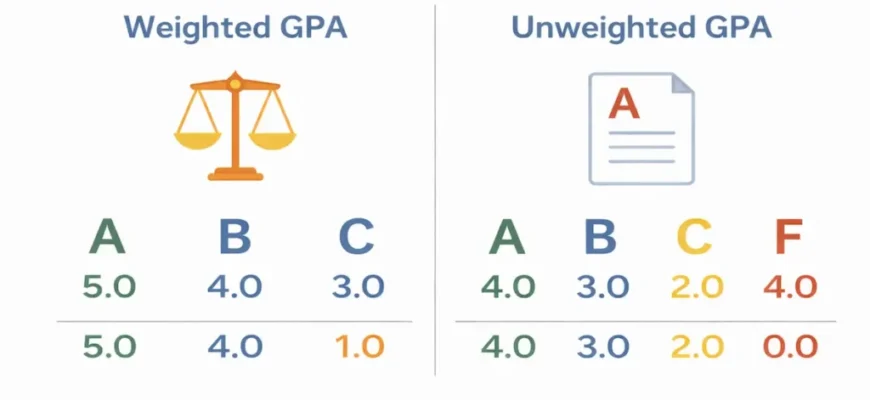
Weighted grades give extra points for harder classes like AP and honors (up to 5.0), while unweighted grades use a standard 4.0 scale.
Weighted
Weighted GPA gives extra points to honors, AP and IB classes. The scale commonly reaches 5.0.
Unweighted
Unweighted GPA ignores course difficulty, with a max of 4.0.
Example
An A in a regular class is 4.0 both ways. An A in AP is 5.0 weighted and 4.0 unweighted.
Which colleges use
Many colleges recalculate GPA on their own scale, so look at both.
How GPA is calculated
Each letter grade is converted to grade points, and then the points are averaged by credit hours. Unweighted: A = 4, B = 3, C = 2, D = 1, F = 0. Weighted: honors courses commonly add 0.5 points and AP or IB courses add 1.0, so an A becomes 4.5 or 5.0.

Example
Take four courses: an AP class with an A (5.0), an honors class with a B (3.5), and two regular classes with an A (4.0) and a B (3.0). The weighted GPA is (5.0 + 3.5 + 4.0 + 3.0) divided by 4, which is 3.875. The unweighted GPA is (4 + 3 + 4 + 3) divided by 4, which is 3.5.
Why schools use weighted GPA
Weighted grades reward students for taking more challenging classes, so a B in AP can count more than an A in a standard class, depending on the school’s system.
How colleges look at it
Many colleges recalculate GPA using their own scale, usually unweighted, or focus on grades in core academic subjects. Admissions officers also consider course rigor, the school profile and class rank when reported.

Scales differ
Weighted scales are not standard. Some schools weight on a 5.0 scale and others on a 6.0 or a 100 point scale, so a number should be read with the school’s grading policy.
Class rank
Many schools use weighted GPA for class rank, valedictorian and scholarships.
Scholarship rules
Some scholarships specify unweighted GPA, so check the requirements.
Planning tip
Take rigorous courses that fit your strengths and ability to maintain good grades. Check the transcript’s school profile to learn how the grading scale is explained.
Typical scales and how colleges use them
Unweighted GPA uses a 4.0 scale in which an A is 4.0, regardless of course difficulty. Weighted GPA adds extra points for harder classes, commonly 1.0 for AP, IB and dual enrollment courses and 0.5 for honors, so an A in AP Calculus counts as 5.0 and the maximum is often 5.0. Some schools use 4.5 or 6.0 scales, and policies vary widely. Colleges often recalculate GPA using their own method, usually unweighted, and look closely at course rigor, grade trends and the school profile. Class rank may use weighted GPA at some schools.

Planning tips
Taking challenging courses can increase weighted GPA, but admissions officers care about whether students challenged themselves in a manageable way. Scholarship programs and the NCAA use specific core course GPA calculations. For example, NCAA Division I requires a minimum core GPA of 2.3 for eligibility. Check your school’s grading policy and ask your counselor how your transcript presents GPA, rank and course levels. Keep an eye on state scholarships such as Florida Bright Futures or Georgia HOPE, which often define their own GPA formula.
Based on data from the NCAA and the College Board