Muscles grow when resistance training causes tiny tears in muscle fibers, and the body repairs them with the help of protein and rest, making them larger.
The process
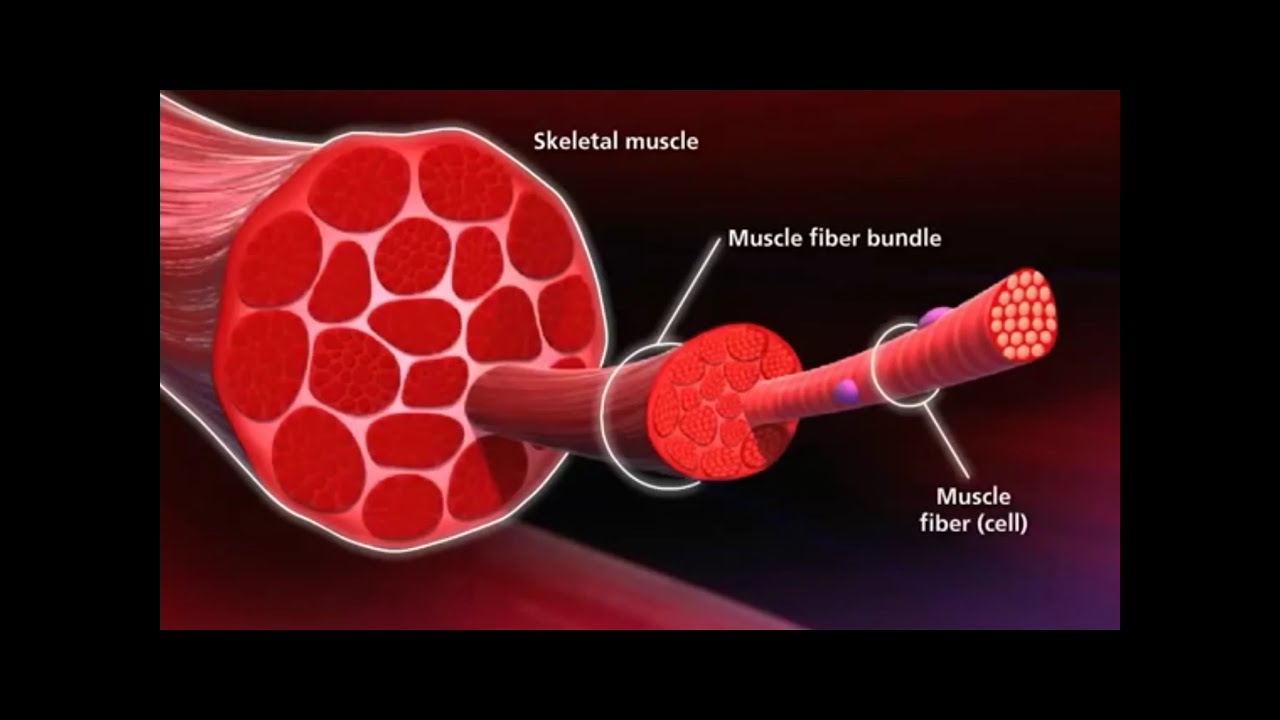
Resistance training causes microscopic damage to muscle fibers. The body repairs them and adds protein, making them thicker (hypertrophy). Satellite cells fuse to the fibers.
Needs
- Progressive overload: lift heavier or do more over time.
- Protein: 1.6 to 2.2 g per kg of body weight (meta-analysis, Morton 2018).
- Enough calories.
- Sleep 7 to 9 hours.
- Rest 48 hours between training the same muscle.
Timeline
Strength gains in weeks, visible size in 8 to 12 weeks.
Hormones
Testosterone, growth hormone and IGF-1 help.
Age
Muscle loss begins around age 30 without training.
Mechanisms
Mechanical tension is the main driver.
The process
Muscle growth, called hypertrophy, happens when the rate of muscle protein synthesis exceeds breakdown. Resistance exercise creates mechanical tension and small tears (microdamage) in muscle fibers. In response, satellite cells, which are muscle stem cells, activate and fuse with fibers to donate nuclei, and fibers add new contractile proteins (actin and myosin) to get larger and stronger. This is driven by the mTOR signaling pathway.
Needs

- Progressive overload: gradually increasing weight, reps or sets. Training each muscle group 2 or more times a week works well.
- Volume: studies suggest about 10 or more hard sets per muscle per week for most people, in the range of 6 to 30 reps per set provided it is taken close to failure.
- Protein: 1.4 to 2.0 grams per kilogram of body weight per day for building muscle, according to the International Society of Sports Nutrition, spread over 3 to 5 meals with about 0.25 to 0.4 grams per kilogram per meal.
- Calories: a small surplus of 5% to 15% above maintenance supports growth, though beginners can gain muscle at maintenance.
- Sleep: 7 to 9 hours. Growth and repair happen during rest.
- Rest days between sessions for the same muscle.
Timeline
Beginners may notice strength gains within 2 to 4 weeks, mostly from nervous system adaptations. Visible muscle size typically takes 8 to 12 weeks. Beginners can gain about 0.5 to 1 kilogram (1 to 2 pounds) of muscle per month in the first year, falling to a much slower pace later. Muscle takes years to maximize.
Hormones
Testosterone, growth hormone and IGF-1 play roles. Men have about 10 times more testosterone than women, which explains why men typically build more muscle. Acute hormone spikes after training have little effect compared with total training volume. Thyroid hormones and insulin also matter.
Age
Muscle mass peaks around age 30 and falls about 3% to 8% per decade after 30, faster after 60 (sarcopenia). Older adults can still build muscle with resistance training and enough protein, at 1.0 to 1.2 grams per kilogram or more.
Mechanisms
The three main drivers are mechanical tension, metabolic stress and muscle damage. Training close to failure with good form is more important than any single technique. Genetics affect how much muscle you gain.

Training variables and muscle science
Muscle grows through hypertrophy, where training damages muscle fibers, and satellite cells help repair and thicken them. Evidence supports training each muscle group at least twice a week with 10 or more hard sets weekly, close to failure, and a rep range of about 5 to 30 reps if sets are hard. Protein intake of roughly 1.6 grams per kilogram of body weight per day, which is 0.7 grams per pound, maximized gains in a 2018 meta analysis in the British Journal of Sports Medicine. Beginners may gain about 0.5 to 1 kg of muscle a month in the early months, with progress slowing over time. Sleep of 7 to 9 hours and a small calorie surplus help. Testosterone and growth hormone play roles, but men and women both build muscle with training. Creatine monohydrate at 3 to 5 grams daily is among the best studied supplements.
Based on data from the British Journal of Sports Medicine and the American College of Sports Medicine