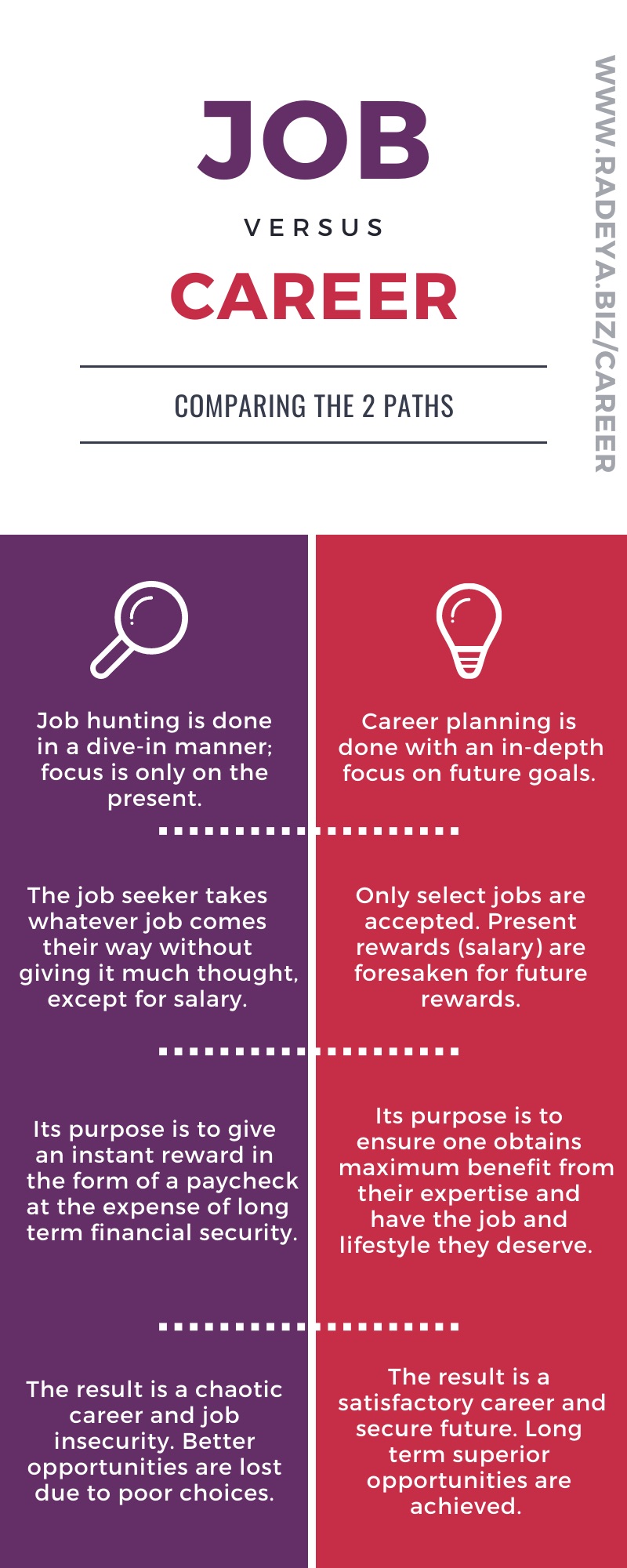
A job is work you do for pay, while a career is a long-term path of growth and advancement in a field.
Job
A job is work you do for pay, often short-term and focused on tasks and income.
Career
A career is a long-term path of work, learning and advancement in a field, often across many jobs and employers.
Key differences
- Time: a job lasts months or years. A career spans decades.
- Goal: income vs growth and fulfillment.
- Skills: a career builds specialized skills and credentials.
Overlap
A job can be a step in a career.
Numbers
The BLS reports the average US worker holds about 12 jobs in their lifetime (NLSY79, 1978 to 2018 cohort).
Planning
Set goals and seek mentors, training and promotions.
Tip
Ask yourself what you want in 5 to 10 years.
Job in detail
A job is a specific position or set of tasks performed for pay, such as cashier, driver or accountant. A job can be short-term, may not require long-term planning, and mainly provides income. People may hold several jobs at once or change jobs often. The US Bureau of Labor Statistics reports that the average American holds about 12 jobs between ages 18 and 56.
Career in detail
A career is a long-term path of work and learning, often in a field, with progression, skills development and goals. It may include many jobs over time, such as an engineer moving from junior engineer to manager to director. Careers typically involve education, training, certifications and professional networks. The word comes from the Latin “carraria,” a road for carriages.
Key differences
- Time: a job is short-term, a career spans decades.
- Purpose: a job pays bills, a career builds skills, status and fulfillment.
- Growth: a career includes advancement, a job may not.
- Training: careers often require formal education or credentials.
- Identity: a career is often tied to personal identity and goals.
Overlap
A job can be a step in a career, and a career includes jobs. People can treat the same work either way. Researcher Amy Wrzesniewski described three orientations toward work: a job (for money), a career (for advancement) and a calling (for meaning and purpose).
Numbers
The median time employees stay with their current employer is 3.9 years, according to the BLS (2024). Americans change careers about 5 to 7 times in their working lives, according to some estimates, though this figure is disputed.
Planning
- Identify strengths, interests and values with assessments such as O*NET Interest Profiler.
- Research growth fields using the BLS Occupational Outlook Handbook.
- Gain skills through courses, certificates and mentors.
- Set goals for 1, 5 and 10 years.
- Network and seek feedback.
- Treat every job as a chance to learn.
Tip
If you currently have a job that does not match your goals, look for ways to gain transferable skills, ask for stretch projects, and plan a path to a career you want.

Labor market statistics
A job is typically a position held for pay, often short term or tied to a specific task, while a career is a long term path of related roles that builds skills and advancement. The Bureau of Labor Statistics’ National Longitudinal Survey of Youth found that baby boomers held an average of 12.7 jobs between ages 18 and 56. The median employee tenure in the US was about 3.9 years in January 2024. Careers are often shaped by education, experience and networking, and many people switch fields several times. Workers with a bachelor’s degree earn a median of about 1,493 USD per week, compared with about 899 for those with a high school diploma only, per BLS 2023 data. Planning steps include assessing interests and strengths, using the Occupational Outlook Handbook to explore job growth, building skills through courses or certifications, and finding mentors.
Based on data from the Bureau of Labor Statistics