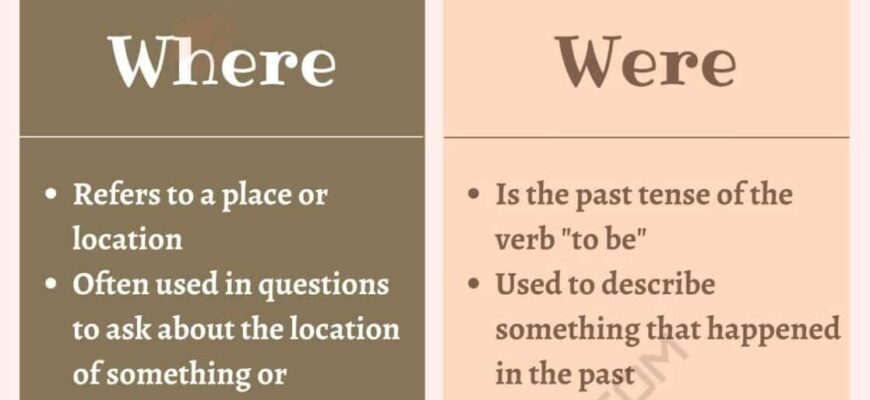
“Where” refers to a place, and “were” is the past tense of “are,” as in “they were late.”
Where
“Where” asks about a place or location: “Where is the library?”
Were
“Were” is the past tense of “are” (plural or you): “They were late.” Also used in the subjunctive: “If I were you”.
Memory tip
“Where” has “here” in it, showing a place. “Were” has no “h”, so it’s a verb.
Examples
- Where were you yesterday?
- We were at home.
Common mistake
Writing “were” when you mean “where” (“Were are you going?”).
Similar pairs
“We’re” (we are), “wear” and “ware”.

Pronunciation
“Where” sounds like “wair”; “were” sounds like “wur”.
Where as a place word
“Where” asks about or refers to a place or position. It is an adverb and a conjunction.
- Where is the train station?
- I know where she left the keys.
- This is the town where I grew up.
Were as a verb form
“Were” is the past tense of “to be” for you, we, they and plural nouns, and it is also the subjunctive form for hypothetical statements.
- They were late to the meeting.
- If I were you, I would call first.
- We were there last week.
- Were you at the party?

Spelling clues
- “Where” has “here” inside it, and “here”, “there” and “where” all relate to place.
- “Were” has no “h”, and it has the same ending as “are”, which is also a form of “be”.
Typical errors
- Wrong: “Were are you going?” Right: “Where are you going?”
- Wrong: “We where happy.” Right: “We were happy.”
- Typing mistakes happen because the words differ by one letter and spell checkers do not flag either word.
Sound
In US English, “where” is pronounced /wɛr/ and rhymes with “care”. “Were” is /wɝ/ when stressed and rhymes with “fur”, but in fast speech it is often reduced to /wɚ/.
Similar word pairs
Other pairs that cause errors: there, their and they’re; your and you’re; its and it’s; then and than; affect and effect.
Proofreading tips
Read the sentence aloud and replace the word with “at what place”. If the sentence still works, use “where”. If the word acts as a past tense of “be”, use “were”.
Quick test
Try swapping with “was”. If “was” fits grammatically for a singular subject, “were” is the plural or subjunctive counterpart. If you are talking about a location, you need “where”.
Grammar and usage examples
“Where” refers to a place or location, as in “Where are you going?” or “Where did you put the keys?” “Were” is the past tense of “are” used with you, we, they and plural subjects, as in “They were late” or “We were happy.” “Were” is also used in the subjunctive for hypothetical situations, such as “If I were you, I would call.” A simple memory tip is that “where” contains “here” and “there,” which are also place words. “Were” has no “h,” and rhymes with “fur” in many accents, while “where” rhymes with “air.”

Typical mistakes and checks
Common errors include writing “Where you there?” instead of “Were you there?” and “We where happy” instead of “We were happy.” In a quick test, replace the word with “was”: if the sentence works in the past tense with a singular subject, “were” is likely right. If you can replace it with “in what place,” use “where.” Similar confusable pairs include wear and where, were and we’re, there and their. Read your text aloud, use spellcheck but also reread, because spellcheck cannot catch correctly spelled wrong words.
Based on data from Merriam-Webster and the Purdue Online Writing Lab