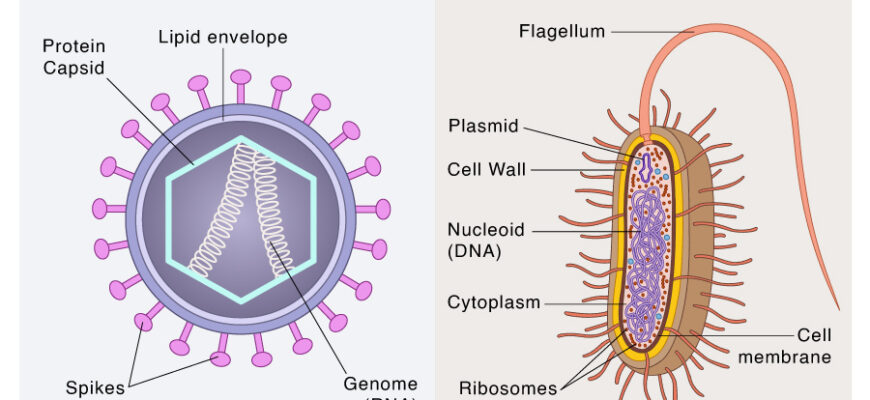
Bacteria are living single-celled organisms treated with antibiotics, while viruses are smaller, need a host cell to multiply, and are not treated with antibiotics.
Bacteria
Bacteria are single-celled living organisms, about 1 to 5 micrometers. Most are harmless or helpful, such as gut bacteria. Some cause strep throat, UTIs and tuberculosis. They can reproduce on their own.
Viruses
Viruses are about 20 to 300 nanometers, 10 to 100 times smaller. They are not cells and need a host cell to replicate. Examples: flu, COVID-19, HIV.
Treatment
Antibiotics treat bacteria but not viruses. Viral infections are treated with antivirals (for flu, HIV) or vaccines.
Misuse
The CDC says antibiotics are prescribed unnecessarily in about 28 percent of outpatient cases.
Prevention

Vaccines, hygiene and food safety.
Some diseases
Pneumonia can be bacterial or viral.
Bacteria
Bacteria are single-celled living organisms, about 1 to 5 micrometers long, that can reproduce on their own. They have a cell wall and DNA but no nucleus. Most are harmless or helpful. The human body contains about as many bacterial cells as human cells, roughly 38 trillion, and gut bacteria aid digestion and immunity. Only a small fraction cause disease.
Viruses

Viruses are much smaller, about 20 to 300 nanometers, and are not considered alive on their own. They are made of genetic material (DNA or RNA) in a protein coat, and sometimes a lipid envelope. A virus must enter a host cell and use its machinery to reproduce.
Treatment
- Bacterial infections are treated with antibiotics, which kill bacteria or stop their growth. Examples are penicillin, amoxicillin and azithromycin.
- Viral infections do not respond to antibiotics. Treatment includes rest, fluids and symptom relief. Some viral diseases have antiviral drugs, like oseltamivir (Tamiflu) for flu, nirmatrelvir (Paxlovid) for COVID-19 and combination therapy for HIV and hepatitis C.
Misuse
Using antibiotics for colds and flu does not help and contributes to antibiotic resistance. The CDC estimates that at least 2.8 million antibiotic-resistant infections occur in the US each year, with more than 35,000 deaths. The WHO lists resistance as one of the top global public health threats. Take antibiotics only when prescribed and as directed.
Prevention
- Vaccines exist for both bacterial and viral diseases, such as tetanus, whooping cough, measles, polio, flu and HPV.
- Wash hands with soap for 20 seconds.
- Cook food to safe temperatures and keep it refrigerated.
- Practice safe sex and avoid sharing needles.
- Stay home when sick.
Some diseases
- Bacterial: strep throat, tuberculosis, urinary tract infections, Lyme disease, cholera, and most cases of pneumonia and ear infection.
- Viral: common cold, influenza, COVID-19, measles, HIV, chickenpox, hepatitis and HPV.
Some illnesses, such as pneumonia, can be caused by either. A doctor may use tests like cultures or PCR to tell which one it is.

Size, structure and reproduction
Bacteria are single celled living organisms about 0.5 to 5 micrometers long, while viruses are about 20 to 300 nanometers, which is roughly 10 to 100 times smaller. Bacteria can reproduce on their own by binary fission, sometimes every 20 minutes under ideal conditions. Viruses are not cells and must invade host cells to replicate. Most bacteria are harmless or beneficial, and the human gut holds trillions of them. Bacterial infections include strep throat, tuberculosis, urinary tract infections and cholera. Viral infections include the common cold, influenza, measles, HIV and COVID-19. Antibiotics do not work on viruses, and antiviral medicines exist only for certain viruses, such as oseltamivir for flu and drugs for HIV and hepatitis C. Vaccines exist for both types, such as the tetanus vaccine (bacterial) and the measles vaccine (viral).
Based on data from the CDC and the World Health Organization