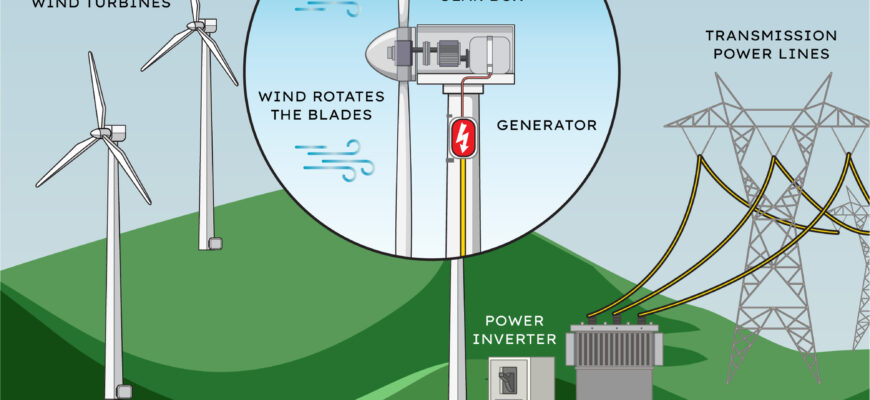
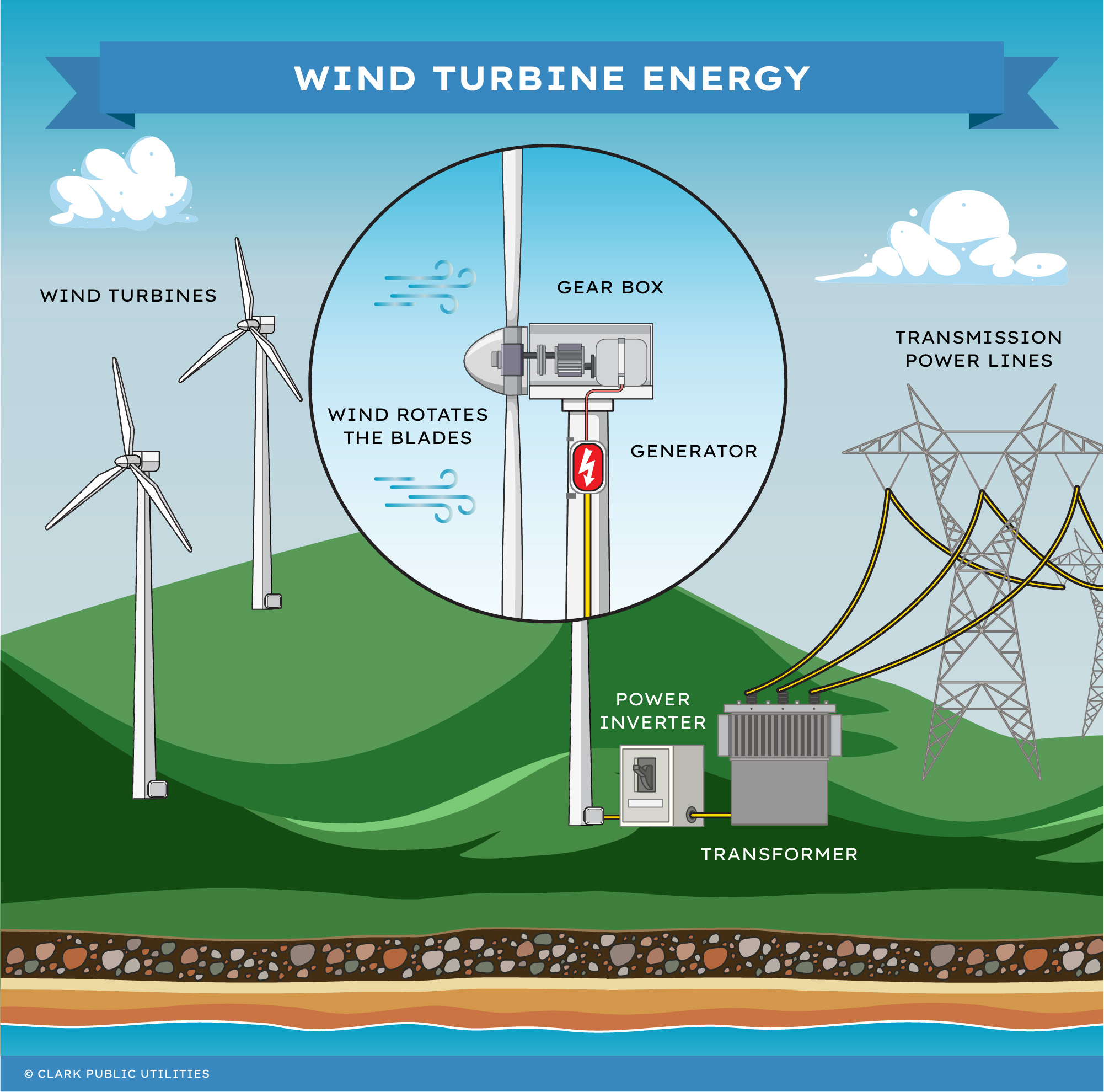
Wind turns the blades of a turbine, which spin a generator that produces electricity.
How it works
- Wind turns the rotor blades.
- The blades spin a shaft connected to a gearbox.
- The gearbox drives a generator, which makes electricity.
- Power travels via cables to the grid.
Key facts
- Turbines start at about 6 to 9 mph wind and cut out near 55 mph.
- Modern onshore turbines produce 2 to 3 MW. Offshore ones reach 12 MW or more.
- A single 2.5 MW turbine can power around 600 homes.
Cleaner
Wind has no fuel emissions.
Turbine design
Most turbines have three blades attached to a hub (rotor) on a tower. Wind flows over the blades, creating lift and making them rotate, much like an airplane wing. The rotor turns a shaft connected to a generator, often through a gearbox.
Size
Modern onshore turbines have rotor diameters of 100 to 160 meters and capacities of about 2 to 6 megawatts. Offshore turbines can reach 12 to 15 megawatts with blades over 100 meters long.
Cut in and cut out speeds
Turbines start producing power at wind speeds of about 3 to 4 meters per second (7 to 9 mph), reach rated power at about 12 to 15 meters per second, and shut down at about 25 meters per second to avoid damage.
Power formula
Power in wind rises with the cube of wind speed. Doubling the wind speed gives eight times the power. The Betz limit says a turbine can capture at most 59.3% of the energy in the wind.
Control
Anemometers measure wind speed, and the nacelle yaws to face the wind. Blades pitch to regulate speed.
Capacity factor
Onshore wind turbines in the US had an average capacity factor of about 35% in recent years, and offshore wind often reaches 40% to 50%.
Share of electricity
Wind produced about 10% of US electricity in 2023 according to the Energy Information Administration, and about 7.8% of global electricity.
Lifecycle emissions
About 11 to 12 grams of CO2 equivalent per kilowatt hour, among the lowest of electricity sources.
Impacts
Wind farms can affect birds and bats, and noise and visual effects. Studies estimate that far more birds die from cats and buildings.
Cost
Onshore wind is among the cheapest sources of new electricity in many regions, according to Lazard analyses.
Turbine physics
Wind turbines convert the kinetic energy of wind into electricity. The power available in the wind is P = 0.5 x air density x swept area x wind speed cubed, so doubling wind speed gives eight times more power. The Betz limit says no turbine can capture more than 59.3 percent of the wind’s energy, and real turbines reach about 40 to 50 percent. Most modern turbines have three blades, begin generating at a cut in speed of about 3 to 4 m/s, reach rated power around 12 to 14 m/s and shut down at about 25 m/s to protect the machine.
Capacity and share
The average capacity factor for US wind is about 35 percent, meaning a 2 megawatt turbine produces around 6,100 megawatt hours a year, enough for roughly 580 average homes. Wind supplied about 10 percent of US electricity in 2023, and global installed wind capacity passed 1,000 gigawatts in 2023, according to the Global Wind Energy Council. Lifecycle emissions are about 11 grams of CO2 per kilowatt hour, according to the IPCC. Concerns include bird and bat collisions, noise and visual impact, while offshore wind offers stronger and steadier winds.
Based on data from the US Department of Energy and the Global Wind Energy Council