Earthquakes happen when tectonic plates slip along faults and suddenly release stored energy.
Cause
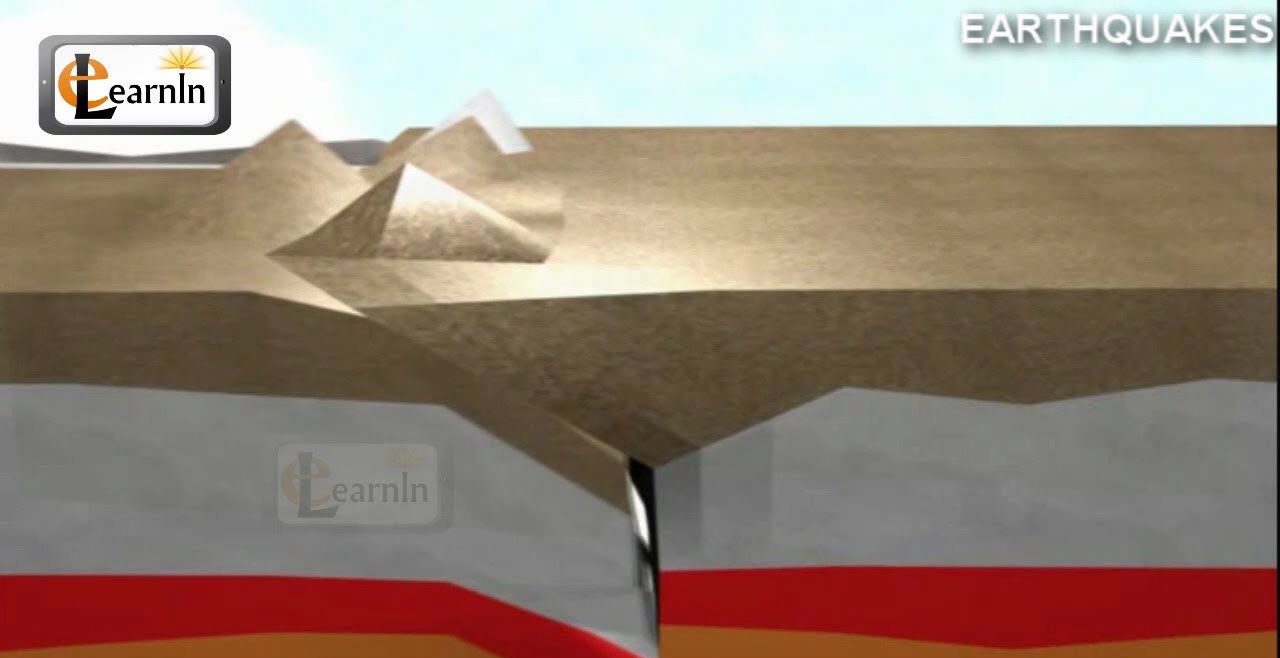
Earth’s crust is split into tectonic plates that move a few centimeters a year. Stress builds along faults where plates lock. When rock suddenly slips, stored energy is released as seismic waves.
Terms
- Focus (hypocenter): where it begins underground.
- Epicenter: point on the surface above.
- Magnitude: measured by the moment magnitude scale.
Where
About 90 percent of earthquakes occur on the Ring of Fire around the Pacific.
Numbers
The USGS records about 20,000 earthquakes a year, with around 15 of magnitude 7 or higher. The strongest recorded was magnitude 9.5 in Chile in 1960.
Other causes
Volcanoes, mining and fluid injection.

Safety
Drop, cover and hold on.
What causes earthquakes
The Earth’s outer shell, the lithosphere, is broken into tectonic plates that move a few centimeters a year, about as fast as fingernails grow. Plates stick against each other along faults. Stress builds until the rock slips, releasing stored energy as seismic waves. The point where slip starts underground is the focus (hypocenter), and the point on the surface above is the epicenter.
Types of plate boundaries
- Convergent: plates collide, and one slides under the other (subduction). These produce the largest earthquakes, including the 2011 Japan quake of magnitude 9.0 and the 1960 Chile quake of magnitude 9.5, the biggest ever recorded.
- Transform: plates slide past each other, as along the San Andreas Fault in California.
- Divergent: plates move apart, as at mid-ocean ridges, with generally smaller quakes.
Where they happen

About 90% of earthquakes and 81% of the largest ones happen along the Ring of Fire around the Pacific Ocean. Other belts include the Alpide belt, from Indonesia through the Himalayas to the Mediterranean. Quakes also occur within plates, such as the 1811 to 1812 New Madrid sequence in Missouri.
Measuring earthquakes
The moment magnitude scale (Mw) replaced the Richter scale for large quakes. Each whole number increase means about 32 times more energy released and 10 times more ground motion. The Modified Mercalli scale describes shaking intensity from I to XII based on effects. Seismographs and the global network detect more than 100,000 quakes a year, with around 15 above magnitude 7.
Numbers and impact
The USGS records roughly 20,000 earthquakes a year worldwide, which is about 55 a day. The deadliest in modern history was the 2010 Haiti quake, with estimates of 100,000 to 316,000 deaths, and the 2004 Indian Ocean quake and tsunami killed about 230,000 people.
Other causes
Volcanic activity, landslides, mining, reservoir filling and wastewater injection from oil and gas operations can trigger quakes. Oklahoma went from about 2 magnitude 3 quakes a year to hundreds a year in 2015, linked to wastewater disposal.
Can they be predicted
No method can predict the time, place and size of an earthquake. Scientists give probabilities, such as a 72% chance of a magnitude 6.7 or larger quake in the San Francisco Bay Area by 2043, based on the USGS. Early warning systems like ShakeAlert give seconds of notice.
Safety
During shaking, drop, cover and hold on under a sturdy table. Stay away from windows. Outside, move away from buildings. Near the coast, move to high ground after a strong quake in case of a tsunami.
Famous earthquakes and measurements
The strongest earthquake recorded was the 1960 Valdivia earthquake in Chile, magnitude 9.5. The 2004 Indian Ocean earthquake (magnitude 9.1) caused a tsunami that killed about 230,000 people, and the 2011 Tohoku earthquake in Japan (magnitude 9.1) led to the Fukushima nuclear accident. The Richter scale was developed in 1935 by Charles Richter and has been replaced for large quakes by the moment magnitude scale. Each whole number increase is about 32 times more energy. The USGS records about 20,000 earthquakes per year, and about 15 reach magnitude 7 or above.
Based on data from the US Geological Survey