Temperature measures the average energy of motion of particles, while heat is the transfer of thermal energy between objects.
Temperature
Temperature measures the average kinetic energy of particles in a substance. Units: Celsius, Fahrenheit, kelvin.
Heat
Heat is the transfer of thermal energy between objects at different temperatures. Units: joules or calories.
Key point
Heat flows from hot to cold until they reach thermal equilibrium.
Example
A bathtub of warm water has more heat energy than a cup of boiling water, though the cup has a higher temperature.
Depends on
Heat depends on mass, material and temperature. Temperature doesn’t depend on amount.
Instruments
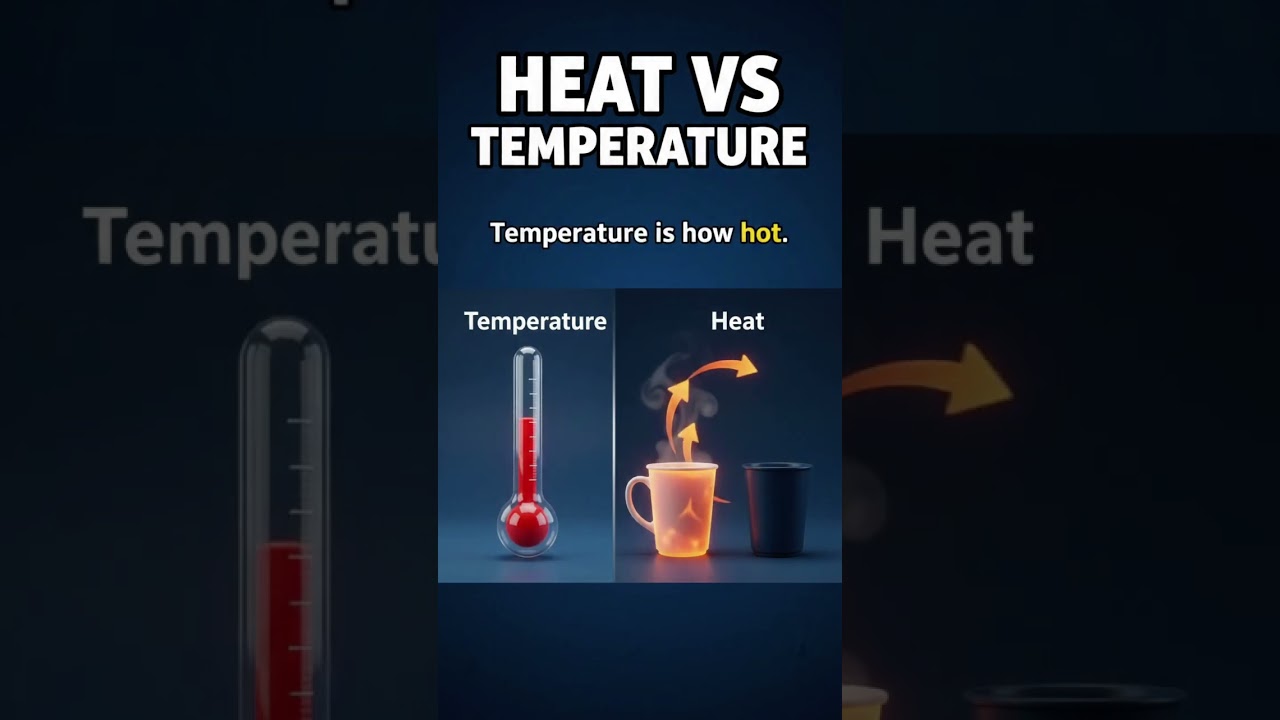
Thermometer measures temperature, calorimeter measures heat.
Specific heat
Water needs 4.18 J to raise 1 gram by 1 C.
Units
- Temperature is measured in degrees Celsius, Fahrenheit or kelvin.
- Heat is energy, so it is measured in joules, calories or BTU.
Heat and mass
A large pot of warm water holds far more thermal energy than a cup of hotter water. The pot has a lower temperature but more heat, because heat depends on the amount of matter.

Heat flow
Heat always flows from a hotter object to a colder one until both have the same temperature. This is the second law of thermodynamics in everyday form.
How heat moves
- Conduction: direct contact, like a spoon in hot soup.
- Convection: movement of fluids, like warm air rising.
- Radiation: electromagnetic waves, like the Sun warming the Earth, which does not need a medium.
Specific heat of water
Water needs about 4.18 joules to raise 1 gram by 1 degree C, much higher than most materials. This is why oceans warm slowly and moderate climate.
Absolute zero
Absolute zero is 0 kelvin, or minus 273.15 degrees C. Temperature there is the lowest possible, as particles have minimal motion.
Latent heat
During melting or boiling, heat goes into changing the state rather than raising the temperature. Ice at 0 degrees C needs about 334 joules per gram to melt.
Units and the physics of heat
Heat is energy transferred because of a temperature difference, and it is measured in joules (J) in the SI system, or in calories and British thermal units (BTU). One calorie is 4.184 joules, and one BTU is 1,055 joules. Temperature measures the average kinetic energy of particles and is measured in kelvin, Celsius or Fahrenheit. Water boils at 100 C (212 F) at sea level, and absolute zero is 0 K, or -273.15 C, the lowest possible temperature. Two objects at the same temperature can hold different amounts of heat: a bathtub of warm water holds far more thermal energy than a cup of water at the same temperature, because heat depends on mass and material.

Specific heat and phase changes
Specific heat is the energy needed to raise 1 gram of a substance by 1 degree Celsius. Water has a high specific heat of 4.18 J/g per C, which is why oceans moderate climate and why water heats slowly. Iron has about 0.45 J/g per C, so it heats up quickly. Heat moves by conduction (direct contact), convection (movement of fluids) and radiation (electromagnetic waves, as from the Sun). During phase changes such as melting ice at 0 C, the temperature stays constant while heat is absorbed as latent heat. Melting 1 gram of ice takes about 334 joules, and vaporizing 1 gram of water takes about 2,260 joules.
Based on data from NASA and the National Institute of Standards and Technology