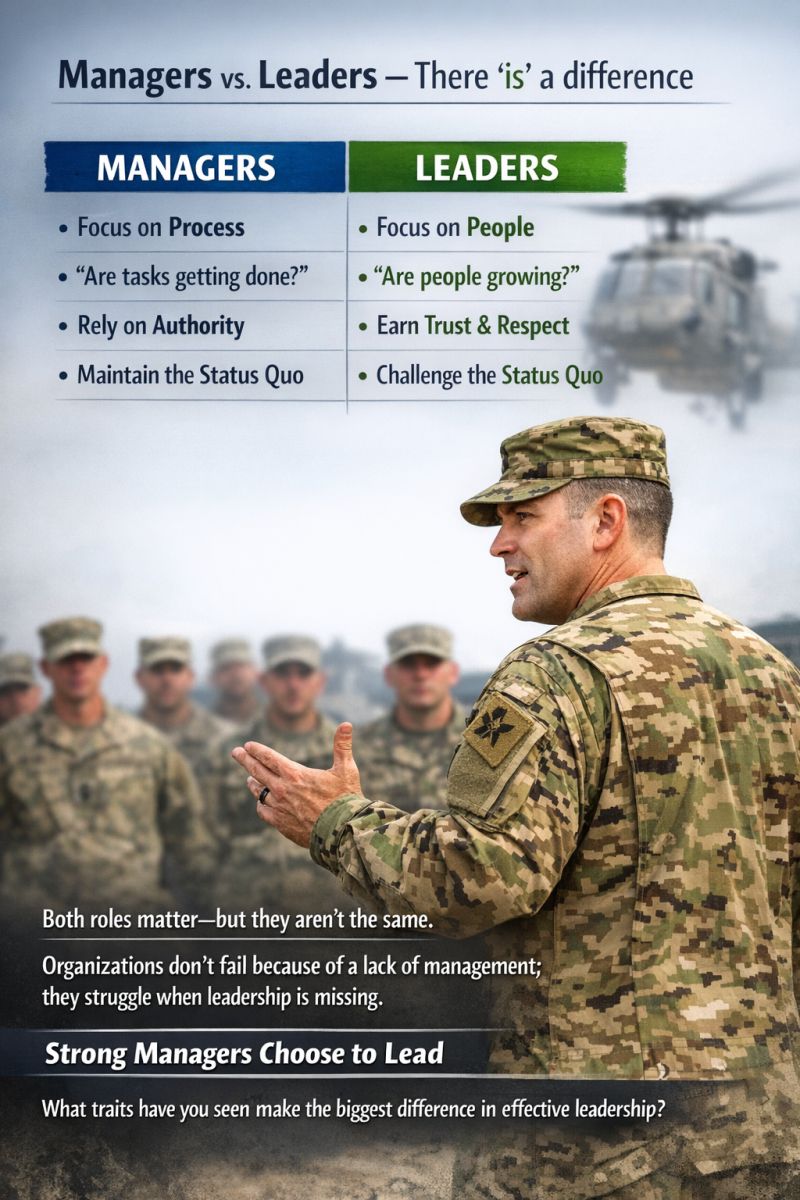
Leaders set a vision and inspire people, while managers organize resources and run day-to-day processes.
Leaders
Leaders set a vision, inspire and motivate people, and drive change. They focus on direction and influence, and people follow by choice.
Managers
Managers plan, organize, coordinate resources and ensure that goals are met. They focus on processes, budgets and performance.
Differences
- Leaders ask “what and why”; managers ask “how and when.”
- Leaders innovate; managers administer.
- Leadership is influence; management is authority.
Overlap
Good managers lead, and leaders manage.
Source
John Kotter of Harvard Business School separated the roles in 1990: management copes with complexity, leadership with change.
Skills

Leaders need vision and communication. Managers need planning and organization.
Tip
Most roles need both.
Typical managerial tasks
- Planning budgets and schedules.
- Hiring, evaluation and performance reviews.
- Allocating resources and tracking results.
- Making sure processes and policies are followed.
Typical leadership tasks
- Setting a vision and explaining why it matters.
- Inspiring and motivating people.
- Encouraging change and innovation.
- Building trust.

Research basis
John Kotter at Harvard Business School argued in 1990 that management copes with complexity while leadership copes with change. Both are needed for an organization to succeed.
Authority
A manager has formal authority from a job title. A leader can have influence without any title, for example an experienced colleague who others follow.
Styles
Leadership styles studied include transformational, transactional, servant and situational. Research suggests that transformational leadership correlates with higher team performance and satisfaction.
Gallup finding
Gallup reports that managers account for about 70% of the variance in team engagement scores.
Developing both
Good managers can learn leadership through coaching, feedback, training and mentoring. Skills include listening, delegation, clear communication and decision making.
Differences in focus
Managers are responsible for planning, budgeting, organizing, staffing and controlling to produce predictable results, while leaders set a direction, align people and motivate them to change. The distinction was popularized by Harvard professor John Kotter, who wrote that management copes with complexity while leadership copes with change. A manager’s authority usually comes from a formal position, and a leader’s influence can come from trust, expertise or vision, and people can lead without holding a title. Common leadership styles include transformational, servant, democratic and autocratic, and the best style depends on the situation and the team.
What research says about both roles
A Gallup analysis of more than 2.5 million manager-led teams found that the manager accounts for at least 70 percent of the variance in employee engagement scores across business units. Gallup also reports that only about 1 in 10 people have the talent to manage well. Good managers coach, give clear expectations and regular feedback, and Gallup finds that employees who receive daily feedback from managers are far more likely to be engaged than those who get it annually. Organizations often promote strong individual contributors to manager roles without training, which is a common cause of poor performance. Most workers benefit when managers also develop leadership skills such as vision, communication and trust building.
Based on data from Gallup and Harvard Business Review