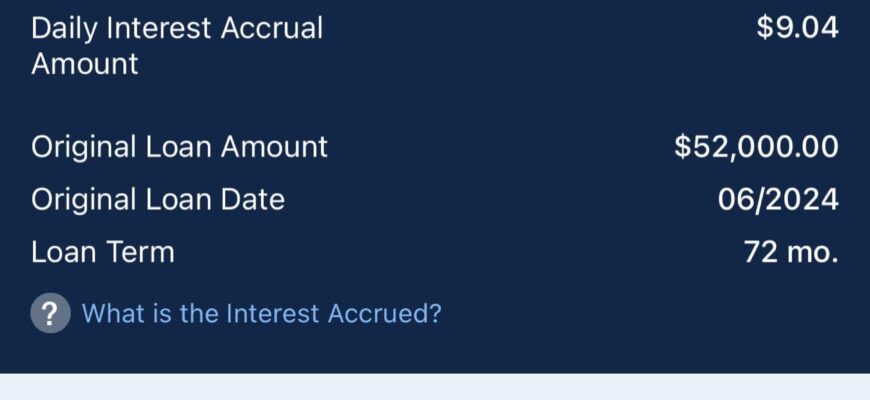
Interest on a car loan is usually charged daily on the remaining balance, so early payments go more to interest and later payments more to principal.
How interest works
Most auto loans use simple interest, charged daily on the remaining principal.
Formula
Daily interest equals balance times APR divided by 365.
Example
A $25,000 loan at 7% for 60 months costs about $495 per month and about $4,700 in total interest.
Amortization
Early payments go mostly to interest, later ones mostly to principal.
Ways to save
- Make a larger down payment.
- Pay extra toward principal.
- Pick a shorter term.
- Get preapproved.

Simple interest on car loans
Most auto loans use simple interest, which is calculated daily on the remaining principal. Paying early or extra reduces the principal and the interest charged going forward.
Formula for payment
Monthly payment = P x r / (1 – (1 + r) to the power of minus n), where P is the loan amount, r is the monthly rate (APR divided by 12) and n is the number of months.
Example
For a 30,000 dollar loan at 7% APR for 60 months, the monthly payment is about 594 dollars. Total paid is about 35,650 dollars, so interest is about 5,650 dollars. For 72 months, the payment is about 511 dollars but total interest rises to about 6,800 dollars.
Early payments

In the first months, most of each payment goes to interest. In the above example, the first payment includes about 175 dollars interest and 419 principal.
What influences the rate
Credit score, loan term, down payment, vehicle age (used cars usually have higher rates) and lender type. In 2024, average rates for new cars were about 7% and for used cars about 11%, though they depend on credit, according to Experian.
Negative equity risk
Long loans of 72 to 84 months can leave you owing more than the car is worth.
Ways to save
- Get pre-approved from a bank or credit union before visiting a dealer.
- Make a bigger down payment, ideally 20% for new cars.
- Choose the shortest term you can afford.
- Make extra principal payments, ensuring there is no prepayment penalty.
- Improve your credit score before applying.
Total cost
Look at the total cost, not just the monthly payment.
Simple interest and the payment formula
Most US auto loans use simple interest, which means interest accrues daily on the outstanding principal. The monthly payment is calculated with the formula payment = r x loan / (1 minus (1 + r) to the power of minus n), where r is the monthly rate (annual rate divided by 12) and n is the number of months. For a 30,000 USD loan at 7 percent for 60 months, the payment is about 594 USD, and the total interest is around 5,640 USD. Early in the loan, a larger share of each payment goes toward interest, and later more goes to principal.

Ways to reduce the cost
Making extra payments, or paying a bit more each month toward principal, cuts total interest, as long as the lender applies it to principal and has no prepayment penalty. A shorter term, such as 48 months, has higher payments but less interest. Credit score is the main factor in the rate, so compare offers from banks and credit unions before visiting a dealer. Long loans of 72 to 84 months can leave you owing more than the car’s value (negative equity) because cars depreciate by about 20 percent in the first year. Put more money down and avoid rolling old debt into a new loan.
Based on data from the Consumer Financial Protection Bureau and the Federal Trade Commission