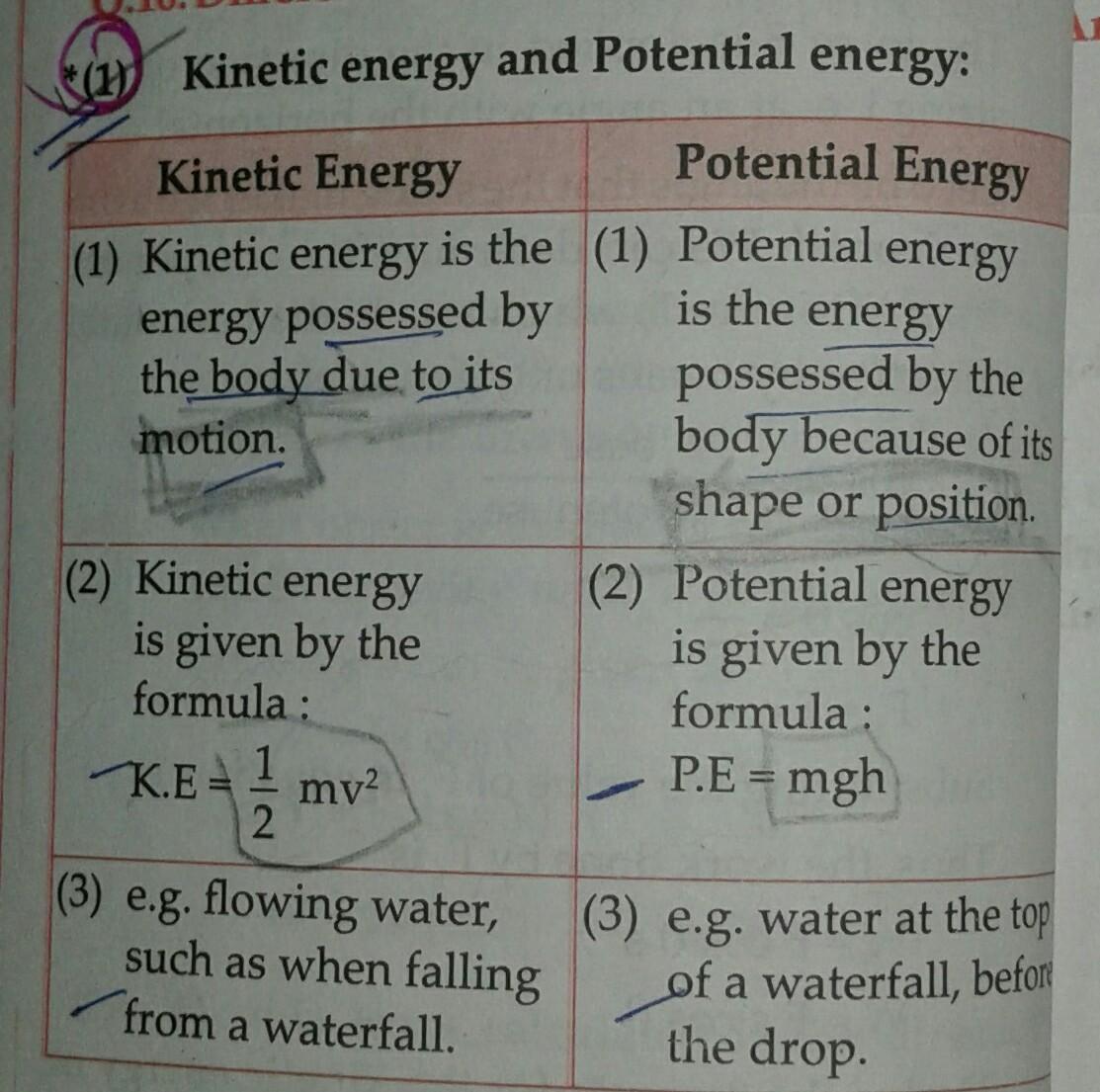
Kinetic energy is the energy of motion, and potential energy is stored energy based on position or condition.
Kinetic energy
Energy of motion: KE = 1/2 x m x v^2. Doubling the speed quadruples the KE.
Potential energy
Stored energy due to position or condition. Gravitational PE = m x g x h. Elastic PE is in springs. Chemical PE in food and fuel.
Units
Both are measured in joules (J).
Conversion
A roller coaster at the top has high PE, converting to KE as it descends. Total mechanical energy stays constant without friction.
Examples
A moving car: kinetic. A book on a shelf: potential.
Law
Conservation of energy.
Example
A 2 kg ball moving at 3 m/s has KE of 9 J.
Kinetic energy in detail
Kinetic energy is the energy of motion. For an object of mass m moving at speed v, the formula is KE = 1/2 m v squared. Doubling the speed quadruples the kinetic energy, which is why high-speed crashes are so destructive. A 1,500 kilogram car at 30 meters per second (about 67 mph) has 675,000 joules of kinetic energy.
Potential energy in detail
Potential energy is stored energy due to position or condition. Gravitational potential energy is PE = m g h, where g is 9.8 meters per second squared and h is the height. A 2 kilogram book 1.5 meters above the floor has about 29.4 joules. Elastic potential energy is stored in stretched springs and bands (1/2 k x squared). Chemical potential energy is stored in fuel and food, and electric potential energy is stored in charged objects and batteries.
Units
Both are measured in joules (J) in the SI system. One joule is the energy needed to lift a one-newton weight one meter. In nutrition, a food Calorie is 4,184 joules.
Conversion
Energy changes from one form to another. A roller coaster at the top of a hill has maximum potential energy and minimum kinetic energy. As it descends, potential energy converts to kinetic energy, and at the bottom, kinetic energy is at its maximum. A swinging pendulum, a bouncing ball and a diver follow the same pattern.
Examples
- Kinetic: a moving car, a flying baseball, flowing water, wind, a runner.
- Potential: a stretched rubber band, water behind a dam, a rock at the edge of a cliff, a compressed spring, a battery.
Law
The law of conservation of energy says that energy cannot be created or destroyed, only transformed. The total mechanical energy (kinetic plus potential) stays constant in a system without friction. In real life, some energy converts to heat and sound due to friction and air resistance.
Example
A 0.5 kilogram ball dropped from 10 meters starts with PE of 49 joules. Just before it hits the ground, almost all of that energy is kinetic, giving a speed of about 14 meters per second, calculated from 1/2 m v squared equals 49.
Formulas and worked examples
Kinetic energy is the energy of motion, KE = 1/2 x m x v squared, where mass is in kilograms, velocity in meters per second and energy in joules. Doubling speed quadruples kinetic energy, which is why car crash energy rises sharply with speed. Gravitational potential energy is PE = m x g x h, with g = 9.8 m/s squared. A 2 kg ball held 10 m above ground has 196 joules of potential energy, and when it falls the energy converts to kinetic, reaching about 14 m/s just before impact when air resistance is ignored. Other forms of potential energy include elastic energy in a spring (1/2 x k x x squared), chemical energy in food and fuel, and electric potential energy. Energy is conserved, so in a closed system the total mechanical energy stays constant, though friction converts some to heat. One food calorie (kcal) equals 4,184 joules.
Based on data from NASA and physics education references