Lightning happens when electrical charge builds up in a storm cloud and discharges as a giant spark between clouds or to the ground.
How it forms
Ice particles and water droplets collide in a storm cloud. This separates charge: positive near the top, negative at the bottom.
The discharge
When the electric field is strong enough, a stepped leader meets a streamer from the ground and a return stroke makes the flash.
Numbers
- A bolt reaches about 30,000°C (54,000°F), five times hotter than the Sun’s surface.
- It carries up to 1 billion volts.
Safety
If you hear thunder, go inside. “When thunder roars, go indoors.”
Charge separation
Inside storm clouds, ice crystals, graupel (soft hail) and supercooled water droplets collide. These collisions transfer electric charge. Lighter positive charged ice crystals rise to the upper part of the cloud, and heavier negatively charged graupel stays in the middle and lower parts. The ground below becomes positively charged.

Breakdown
When the electric field becomes strong enough, about 3 million volts per meter, air breaks down. A stepped leader of negative charge travels toward the ground in jumps of about 50 meters. When it nears the ground, an upward streamer connects, and the bright return stroke follows.
Numbers
- A bolt carries around 30,000 amperes and 300 million volts.
- The channel heats the air to about 30,000 kelvin (about 54,000 degrees F), five times hotter than the surface of the Sun.
- Return strokes travel at about 1/3 the speed of light.
Thunder
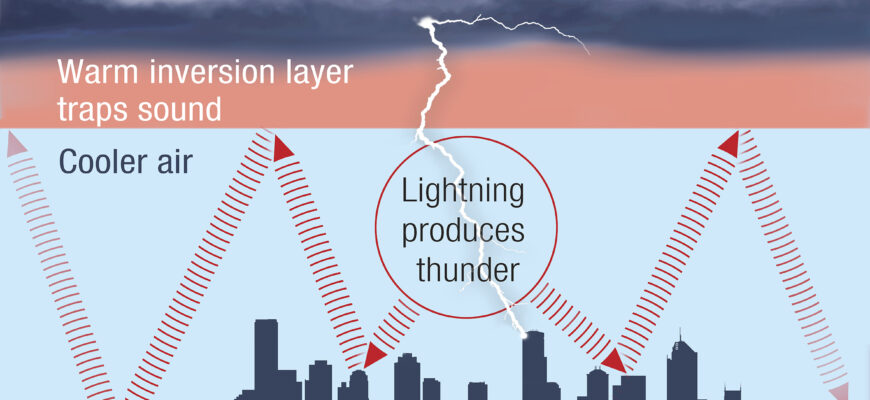
The rapid heating of air creates a shock wave heard as thunder. Count the seconds between lightning and thunder and divide by 5 to estimate distance in miles.
Frequency
The Earth sees about 1.4 billion lightning flashes per year, according to NASA satellite data, or about 44 per second.
Safety
The National Weather Service advises “When thunder roars, go indoors.” Stay inside for 30 minutes after the last thunder. Avoid showers, plumbing and electronics plugged into outlets. Do not shelter under isolated trees. In the US, lightning kills about 20 people per year on average over the last decade.
Types
Cloud to ground, cloud to cloud, intra-cloud and rarely, “bolt from the blue.”
Survivors
Most people struck by lightning survive but may have long term effects. Call 911 and begin CPR if needed, since victims do not carry a charge.
How charge builds up
Inside a thunderstorm cloud, collisions between ice crystals, graupel and supercooled water droplets transfer electric charge, so the top of the cloud becomes positively charged and the bottom negatively charged. When the electric field becomes strong enough to break down the air, a stepped leader moves toward the ground, and a return stroke of current from the ground up produces the bright flash. A strike carries a current of roughly 30,000 amps and heats the air to about 30,000 kelvin, about five times hotter than the surface of the Sun, which causes the air to expand explosively, producing thunder.
Frequency and safety
Earth sees about 100 lightning strikes per second, and the US has around 20 million cloud to ground flashes a year, according to NOAA. Count the seconds between flash and thunder and divide by five to estimate the distance in miles. NOAA advises “When thunder roars, go indoors,” and to wait 30 minutes after the last thunder. Lightning kills an average of about 20 people per year in the US in recent years, and about 90 percent of those struck survive, often with lasting effects. Avoid open fields, tall trees, water and metal objects, and do not use corded phones.
Based on data from NOAA and the National Weather Service