
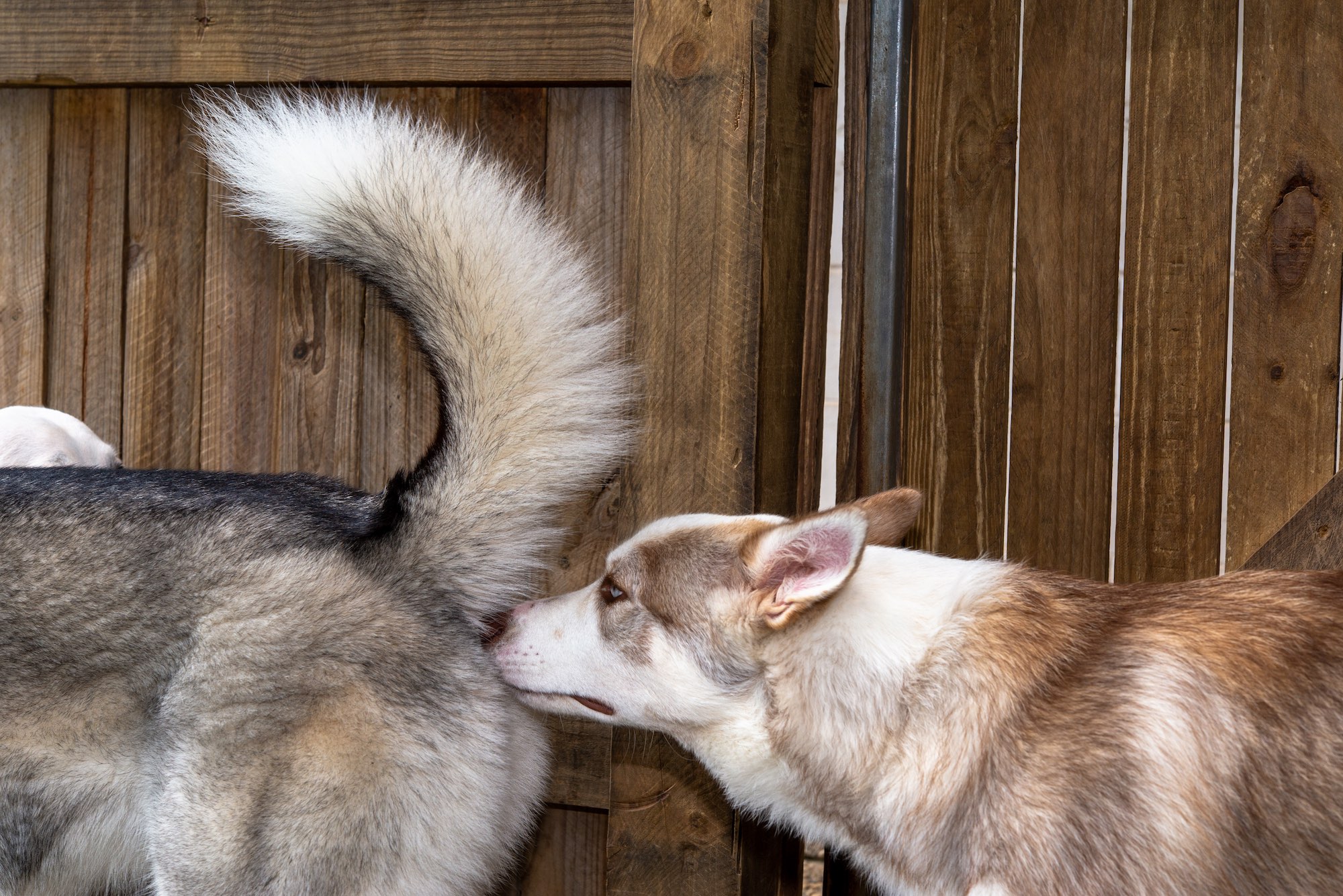
Dogs sniff each other’s rear because scent glands there tell them about identity, age, health, and diet.
Why
Dogs have scent glands (anal glands) that release chemical signals. Sniffing the rear tells them identity, sex, age, diet, mood and health.
Smell power
Dogs have about 300 million scent receptors compared with 6 million in humans. A portion of their brain devoted to smell is 40 times larger.
Greeting
It’s their handshake. The dog that is sniffed allows it as a polite greeting.
Jacobson’s organ
A special organ in the roof of the mouth detects pheromones.
Concern
Excessive sniffing or scooting might signal anal gland problems.
Training
Let dogs greet briefly, but watch for tension.

Don’t
Pull the dog away in the middle of the greeting.
The anal glands
Dogs have two anal sacs, one on each side of the anus, that release a smelly fluid. This fluid contains chemical signals that identify the dog, including its sex, diet, health, mood and reproductive status.
Scent sensing ability
A dog’s nose has up to 300 million olfactory receptors, compared with around 6 million for humans, and the part of the brain that processes smells is about 40 times larger in proportion. A dog can detect some odors at parts per trillion.
Social greeting

Sniffing rear ends is like a handshake or reading a profile. Dogs can tell whether the other dog is familiar, friendly, stressed or in heat.
Vomeronasal organ
Dogs have the vomeronasal (Jacobson’s) organ in the roof of the mouth, which detects pheromones that are not picked up by the usual smell system.
Manners
Brief sniffs are normal. A dog that approaches stiffly, stares or growls may need to be separated.
Training tips
- Allow short greetings, typically 3 to 5 seconds, then call the dog away.
- Reward focusing on you with treats.
- Do not yank the leash, since it adds tension.
- Never punish natural sniffing.
Health aspects
Dogs that are sick, stressed or unwell can smell different, and that affects how others respond. If a dog’s own anal sacs are full, it may scoot on the floor or lick the area, and a vet or groomer can express them.
Socialization
Puppies who meet many dogs between 3 and 14 weeks old, in a safe way with vaccinations, usually have better social skills.
Scent biology
Dogs have around 300 million olfactory receptors, compared with about 6 million in humans, and the part of the brain that handles smell is about 40 times larger in proportion. The vomeronasal (Jacobson’s) organ in the roof of the mouth detects chemical signals such as pheromones. Dogs have two anal sacs that produce a scented secretion with information about identity, sex, diet and health, and sniffing is a way to “read” another dog’s profile. A greeting with nose to rear is normal, polite dog behavior and not a sign of aggression.
Manners and health notes
Let dogs greet briefly on a loose leash. If your dog pulls hard, teach “leave it” and reward calm behavior. A dog scooting its rear on the floor or licking at the area may have full anal sacs, worms or irritation, and needs a vet check. Socialize puppies early between 3 and 14 weeks, and make sure they are vaccinated before meeting unknown dogs. Neutering does not remove sniffing instincts. Watch body language: stiff posture, raised hackles or growling means separate the dogs.
Based on data from the American Kennel Club and the American Veterinary Medical Association







