A traffic light controller switches red, yellow, and green signals using timers and sensors to manage the flow of traffic.
Control
A traffic light controller switches signals in phases using timers, sensors and, in some cities, central computers.
Sensors
- Inductive loops in the road detect metal vehicles.
- Cameras and radar.
- Pedestrian buttons.
Modes
- Fixed-time: cycles by timer.
- Actuated: responds to demand.
- Adaptive: adjusts in real time to traffic.
Signal order
Green, yellow (3 to 6 seconds depending on speed), red. Safety interlocks (conflict monitor) prevent conflicting greens.
History

The first electric traffic light was installed in Cleveland in 1914. Garrett Morgan patented a three-position signal in 1923.
Coordination
Green waves time lights along a corridor.
Control
Traffic lights are run by a controller in a cabinet near the intersection, a small computer programmed with signal timing plans. The controller sends power to the red, yellow and green lamps, and decides when to change based on timers, sensors and coordination with nearby lights. Modern lights use LED lamps, which use about 80% less energy than incandescent bulbs and last 5 to 10 years.
Sensors
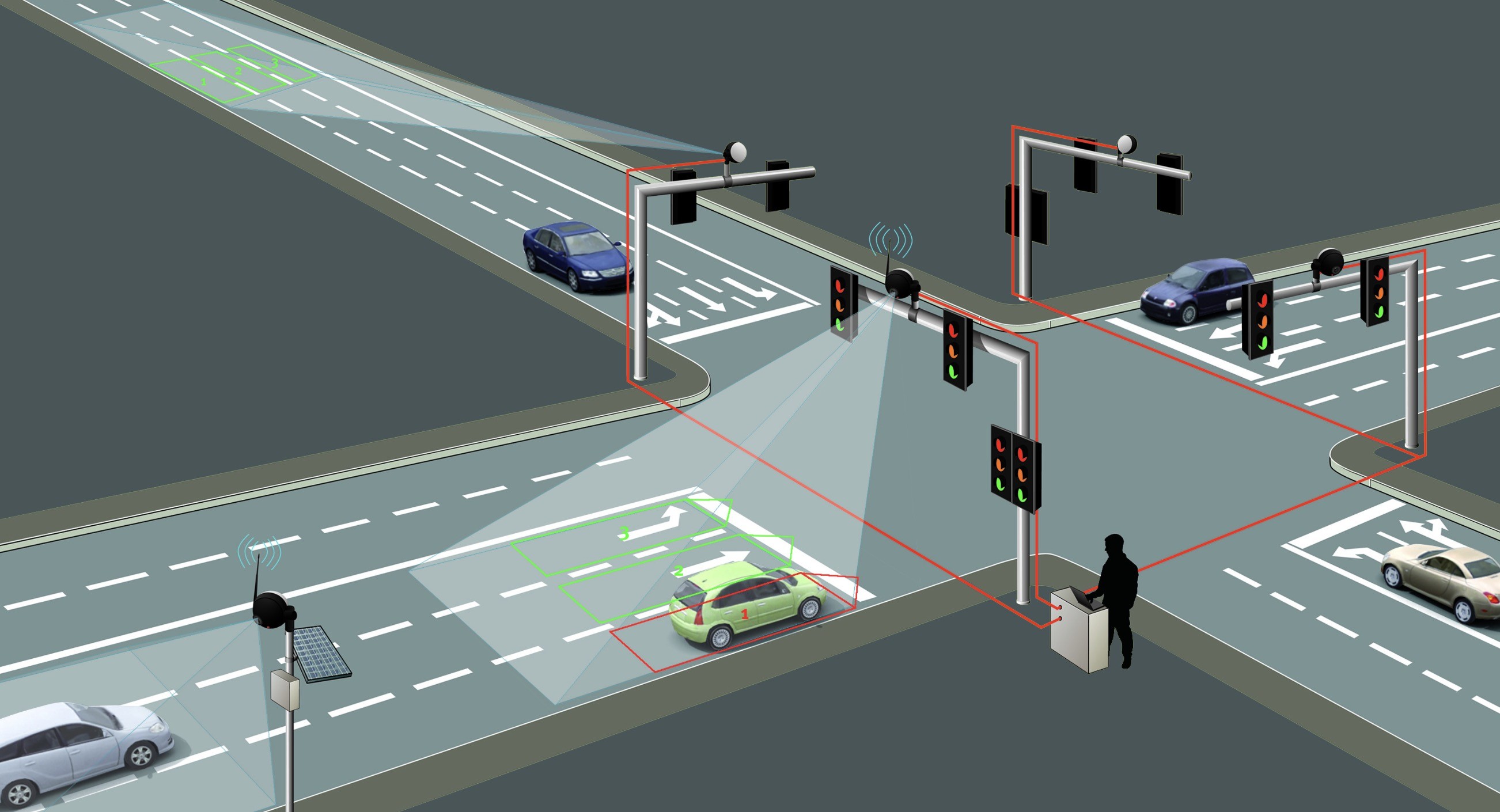
- Inductive loops: wire loops cut into the pavement that detect metal vehicles by changes in inductance. They are the most common type.
- Video detection: cameras that analyze images.
- Radar and microwave sensors.
- Pedestrian push buttons and countdown timers.
- Preemption systems that detect emergency vehicles by infrared, GPS or radio signals and turn the light green for them.
- Bicycle detection.
Modes
- Fixed-time: the same cycle repeats on a schedule, common in downtown grids.
- Actuated: sensors adjust timing to demand, extending green when cars are present and skipping empty phases.
- Adaptive: systems such as SCATS and SCOOT adjust timing in real time across many intersections.
- Flashing mode at night or during failure: red flash is a stop sign, yellow flash means proceed with caution.
Signal order
The usual order is green, yellow, red. Yellow lasts about 3 to 6 seconds depending on speed limit, calculated so vehicles can stop safely. An all-red clearance interval of 1 to 2 seconds often follows yellow. Left-turn arrows and pedestrian phases add complexity.
History
The first traffic signal was installed outside the British Houses of Parliament in London in December 1868, with gas lamps and semaphore arms, and it exploded in 1869. The first electric traffic light was installed in Cleveland, Ohio, in 1914. Garrett Morgan patented a three-position signal in 1923. William Potts of Detroit invented the first four-way, three-color light in 1920. The US has about 330,000 signalized intersections.
Coordination
Signals along a road are timed to create a “green wave” so that vehicles traveling at the speed limit hit successive greens. Better timing reduces stops, fuel use and emissions. The Federal Highway Administration estimates that retiming traffic signals can cut delay by 10% to 20%.

Signal timing standards
In the US, a typical yellow light lasts 3 to 6 seconds, set by the speed limit using engineering formulas from the Institute of Transportation Engineers. A common rule is about 1 second of yellow for each 10 mph of approach speed, so 35 mph roads have around 3.5 to 4 seconds. The all red interval after yellow, usually 1 to 2 seconds, clears the intersection. Controllers are computers in cabinets that follow set timings or respond to detectors such as inductive loops cut into the pavement, video cameras and radar. The first electric traffic signal was installed in Cleveland, Ohio in 1914, and the three color signal was developed by William Potts in Detroit around 1920. Adaptive systems adjust timing in real time and can cut travel time by 10 percent or more. During power failure, signals often flash red and the intersection becomes a four way stop.
Based on data from the Federal Highway Administration and the Institute of Transportation Engineers