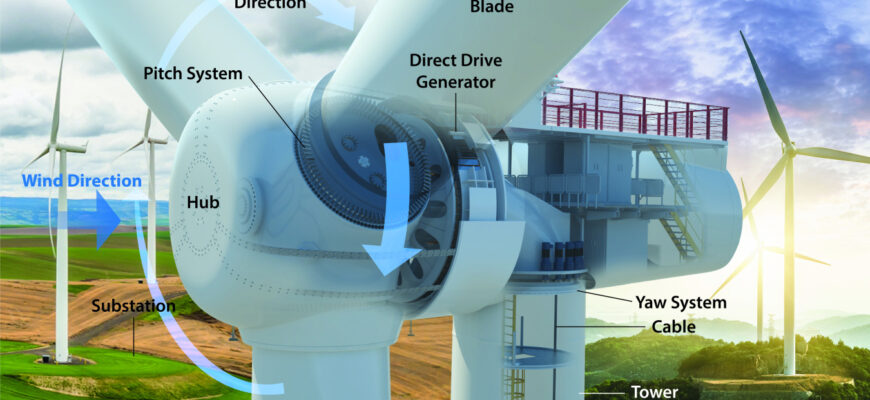
Wind turns the blades of a turbine, which spin a generator that produces electricity.
Steps
- Wind pushes the rotor blades.
- The rotor turns a low speed shaft, then a gearbox raises the speed.
- A generator turns that motion into electricity.
- A transformer raises the voltage for the grid.
Power rating
Modern onshore turbines are 2 to 3 MW. Offshore ones go beyond 12 MW.
Output
A turbine produces power in winds from about 7 mph and shuts down near 55 mph.
Share
Wind supplied about 10% of US electricity in 2023.
Mechanical to electrical
The rotor blades turn a low speed shaft at about 10 to 20 revolutions per minute. A gearbox increases the speed to about 1,000 to 1,800 rpm for a typical generator. Some direct drive turbines use no gearbox.
Generator and power electronics
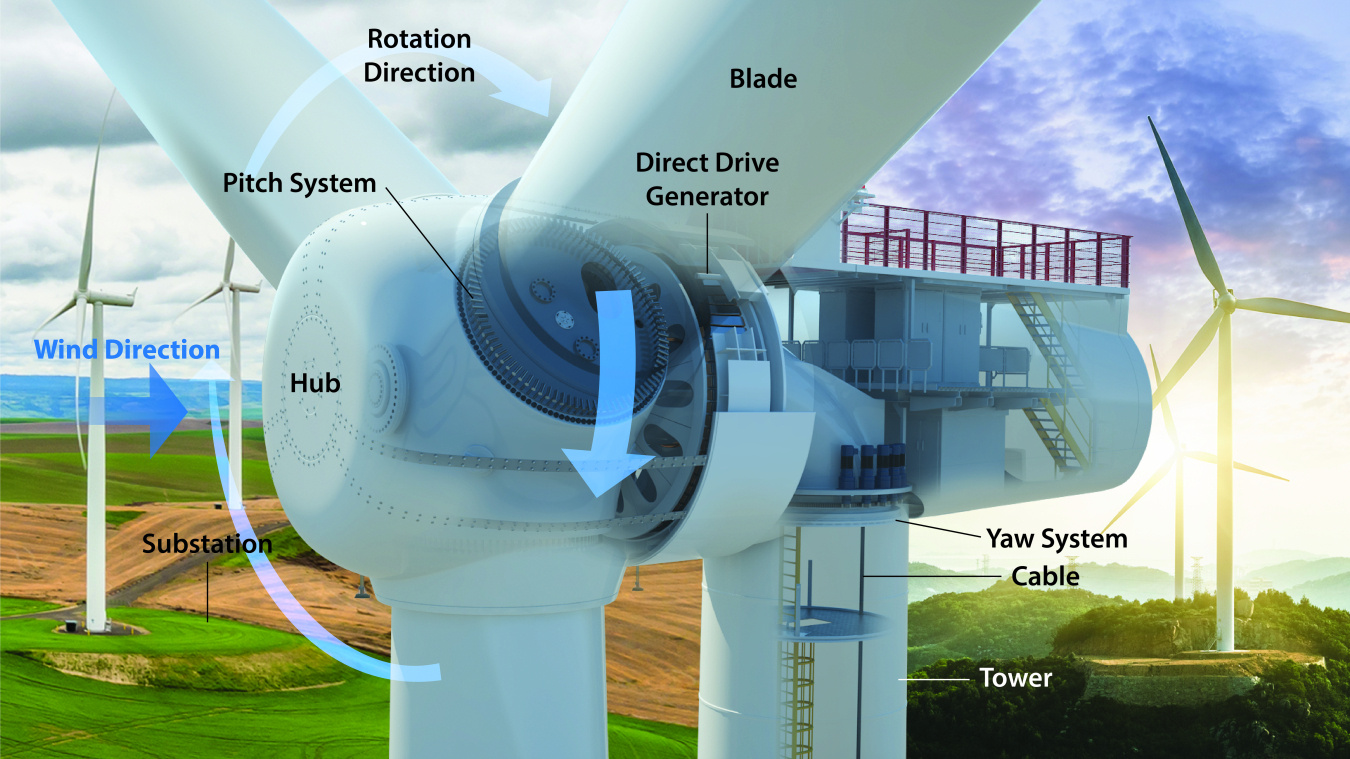
The generator produces alternating current. A converter adjusts frequency and voltage to match the grid at 50 or 60 hertz. A transformer, at the base or in a nearby substation, steps up the voltage for transmission.
Siting
Good sites have steady wind averaging above 6 to 7 meters per second at hub height. Wind speed increases with height, so towers are often 80 to 120 meters tall.
Wind farm
Turbines are spaced about 5 to 10 rotor diameters apart so they do not block each other’s wind. Cables carry power to the substation.
Production example
A 3 megawatt turbine with a 35% capacity factor produces about 9,200 megawatt hours a year, enough for roughly 850 average US homes.

Global capacity
The Global Wind Energy Council reported that global installed wind capacity exceeded 1,000 gigawatts in 2023.
Storage and variability
Wind is variable, so grids use forecasts, interconnections, other sources and storage like batteries to balance supply and demand.
Land use
Turbines take up little land themselves, so farming and grazing can continue between them.
Offshore wind
Offshore turbines benefit from stronger and more consistent winds, but cost more to build and maintain. Floating platforms allow deployment in deeper water.
End of life
Blades are made from fiberglass composites, which are hard to recycle. Companies are developing recyclable blade materials.
From rotation to the grid
Turbine blades turn a shaft connected through a gearbox, or directly in direct drive designs, to a generator that produces alternating current. Power electronics condition the output to match the grid frequency, and a transformer raises the voltage, often from about 690 volts to 34.5 kilovolts for the collection network of a wind farm. The largest offshore turbines now have rated power of 14 to 15 megawatts and rotors more than 220 meters across. Turbines are spaced several rotor diameters apart to limit wake effects.

Variability and storage
Wind output changes with weather, so grid operators use forecasting, a mix of generation sources, transmission and storage such as batteries or pumped hydro to keep supply steady. US wind farms have capacity factors of about 35 percent on average. A 2 megawatt turbine at that rate generates about 6,100 megawatt hours a year. Wind has among the lowest lifecycle greenhouse gas emissions, about 11 grams of CO2 equivalent per kilowatt hour. Siting depends on wind resource maps, land use, wildlife and local approval.
Based on data from the US Department of Energy and the IPCC