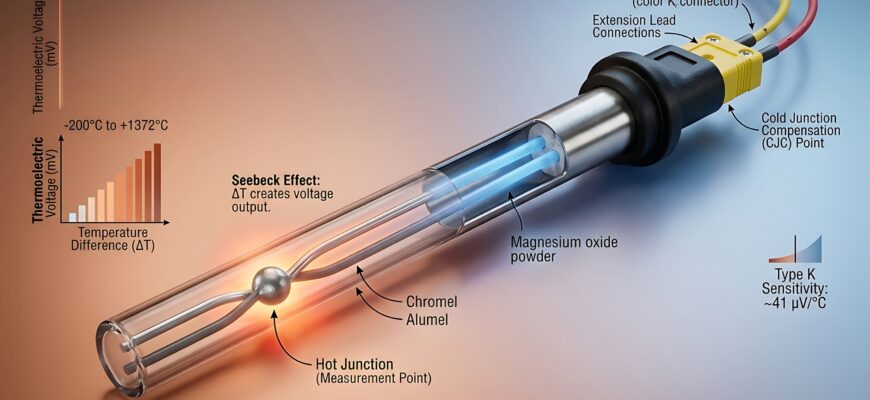
A thermocouple is made of two different metals joined together that produces a small voltage that changes with temperature, which is used to measure temperature.
How it works
Two different metals join at one end. A temperature difference between the junction and the other ends produces a small voltage (the Seebeck effect). The voltage maps to a temperature.
Types
- Type K: nickel based, from -200°C to 1,260°C.
- Type J, T and N are other common types.
Uses
Ovens, furnaces, engines, water heaters and pilot lights.
Accuracy
Typically ±1.5°C or ±0.4%.
Seebeck effect
A thermocouple measures temperature using two different metals joined at one end. A temperature difference between the joined end (hot junction) and the other ends (cold junction) produces a small voltage, known as the Seebeck effect, discovered by Thomas Seebeck in 1821. The voltage is in the millivolt range.

Cold junction compensation
The instrument measures the temperature at the connection point to the meter and adds it to the reading to get the absolute temperature.
Common types
- Type K (nickel-chromium and nickel-alumel): general use, from minus 200 to 1,260 degrees C, most common.
- Type J (iron and constantan): minus 40 to 750 degrees C.
- Type T (copper and constantan): minus 200 to 350 degrees C, good for low temperatures.
- Type S, R and B (platinum based): up to 1,600 to 1,800 degrees C.
Accuracy
Standard grade type K has accuracy about plus or minus 2.2 degrees C or 0.75% of the reading, and special limits grade about half of that. Aging and contamination can cause drift.
Advantages

Wide temperature range, rugged, fast response, low cost and no external power.
Limitations
Lower accuracy than resistance temperature detectors (RTDs), small signals prone to noise and need for correct wiring and compensation.
Uses
Ovens and furnaces, gas appliance safety (pilot light thermocouple), engines, industrial processes and food processing.
In gas appliances
A thermocouple in a water heater or furnace senses the pilot flame. If the flame goes out, the voltage drops and the gas valve closes.
Troubleshooting
A bad thermocouple may cause the pilot to go out. Test with a multimeter, and replace if there’s no millivolt reading.
Voltage output and types
A thermocouple consists of two wires of different metals joined at one end. When the junction is heated, it produces a small voltage proportional to the temperature difference between the hot junction and the reference (cold) junction, known as the Seebeck effect, discovered by Thomas Seebeck in 1821. A type K thermocouple (nickel chromium and nickel alumel) produces about 41 microvolts per degree Celsius and measures from about minus 200 to 1,260 C. Other types include J, T, E, N and the platinum based R and S types for very high temperatures. Standard accuracy of a type K is about 2.2 C or 0.75 percent.

Uses and gas appliance role
Instruments add cold junction compensation, which measures the reference temperature and corrects the reading. Thermocouples are rugged, cheap, fast and used in ovens, engines, furnaces and industrial processes. In gas water heaters and furnaces, a thermocouple in the pilot flame generates about 25 to 30 millivolts that hold the gas valve open. If the pilot goes out, the voltage drops and the valve closes to stop gas flow. A failing thermocouple can cause the pilot to keep going out. Cleaning the tip or replacing the part, which costs a few dollars, often fixes it.
Based on data from the National Institute of Standards and Technology and appliance manufacturers