
Tornadoes form when warm, moist air meets cool, dry air and winds at different heights create a spinning column in a thunderstorm.
Conditions
- Warm, moist air near the ground.
- Cool, dry air above.
- Wind shear (winds changing speed or direction with height).
- An unstable atmosphere.
Steps
- A rotating updraft (mesocyclone) forms in a supercell.
- A funnel cloud extends downward.
- It becomes a tornado when it touches the ground.
Facts
The Enhanced Fujita scale runs EF0 to EF5. The US sees about 1,200 a year.
Safety
Seek a basement or interior room.
Wind shear and rotation
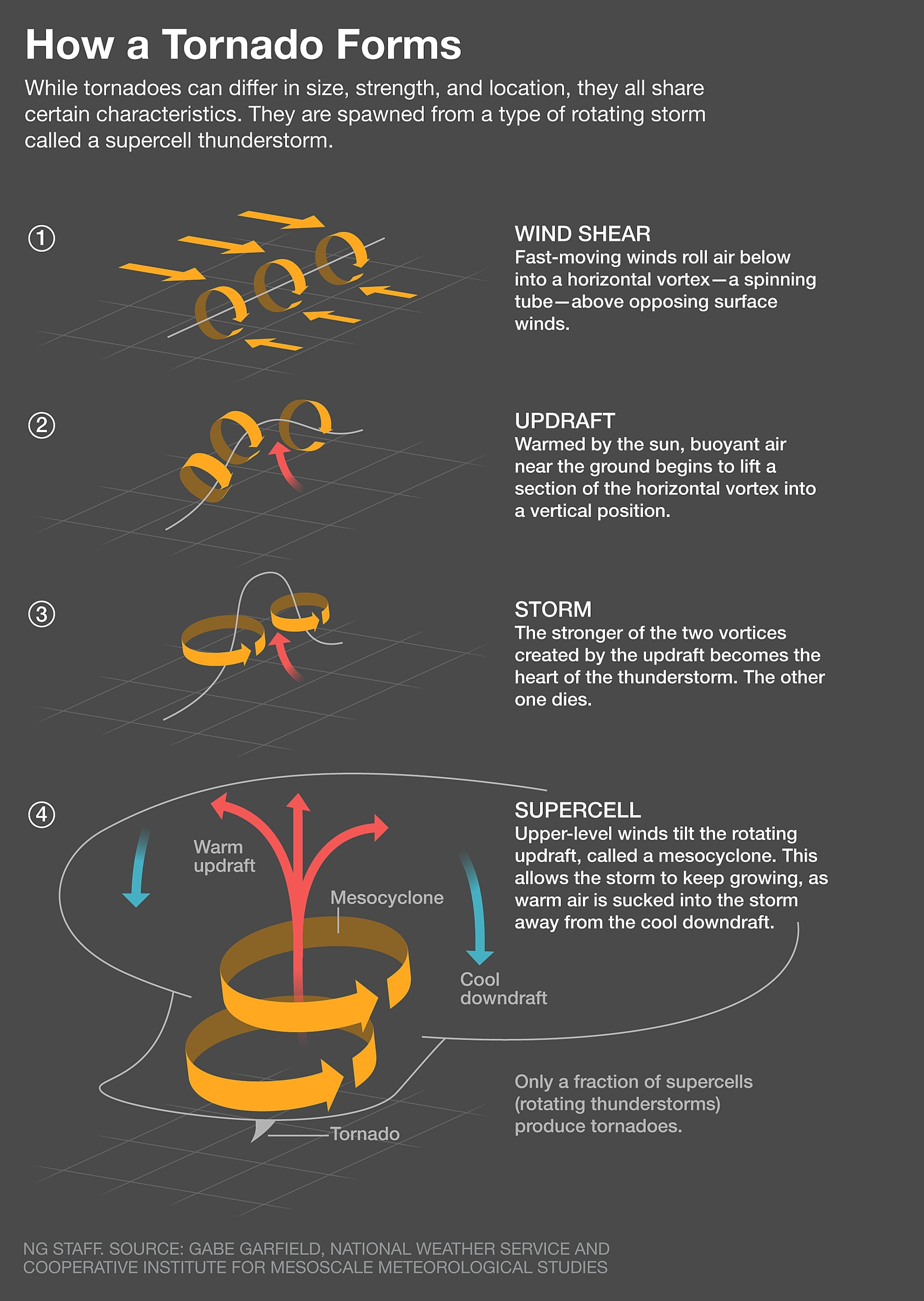
Tornado formation often begins when winds at different heights blow at different speeds and directions. This creates an invisible horizontal rolling tube of air. Updrafts in thunderstorms tilt it vertical, forming a rotating column inside the storm called a mesocyclone.

Funnel and touchdown
A rotating wall cloud may lower, and a funnel cloud forms where low pressure causes condensation. When the circulation reaches the ground, it becomes a tornado. Debris at the ground shows it is a tornado, even without a visible funnel.
Size and speed
Most tornadoes are less than 100 yards wide, but some exceed a mile. The 2013 El Reno, Oklahoma tornado reached 2.6 miles wide, the widest on record. Typical forward speed is 10 to 20 mph, though some move over 60 mph. Path length averages a few miles, but some are over 100 miles.
Strongest winds
The strongest recorded wind, 301 mph plus or minus 20, was measured by a Doppler on Wheels radar in the 1999 Bridge Creek-Moore, Oklahoma tornado.
Time of day
Tornadoes can occur at any time of day, with peak activity from 4 to 9 pm.
Damage and deaths
The deadliest US tornado, the Tri-State Tornado of 1925, killed 695 people. The average annual US death toll in recent years has been about 70.
Waterspouts
A tornado over water is called a waterspout. Fair weather waterspouts are weaker.
Warning signs
- Dark, green sky.
- Large hail.
- A wall cloud.
- A loud roar like a freight train.
- Debris cloud.
Safety
Go to a basement or interior room on the lowest floor, away from windows, and protect your head. Mobile homes are not safe in a tornado.
Supercell mechanics and record numbers
Tornadoes form when strong wind shear, a change in wind speed and direction with height, creates a horizontal rolling tube of air that a thunderstorm updraft tilts upright, forming a rotating mesocyclone. A rear flank downdraft can then wrap around and tighten the rotation near the ground. A funnel becomes visible when low pressure causes condensation, though a tornado can occur without a visible funnel, debris cloud aside. The average tornado is around 150 yards wide, but the widest on record, the El Reno, Oklahoma tornado of 2013, reached 2.6 miles (4.2 km). The highest wind speed measured in a tornado was about 301 mph near Bridge Creek and Moore, Oklahoma, in 1999, recorded by mobile Doppler radar.

Timing and warning signs
Tornadoes occur most often between 4 and 9 p.m. local time and from spring to early summer, though they can happen at any time. The US averages about 70 tornado deaths a year. Warning signs include a dark, greenish sky, large hail, a rotating wall cloud and a loud continuous roar like a freight train. Waterspouts are tornadoes over water. Get to the lowest level of a sturdy building as soon as a warning is issued.
Based on data from NOAA and the National Severe Storms Laboratory




