Solar panels convert sunlight into electricity using photovoltaic cells.
Steps
- Sunlight hits silicon photovoltaic cells.
- Photons knock electrons loose, creating a direct current (DC).
- An inverter converts DC to alternating current (AC).
- Power runs your home or goes to the grid.
Efficiency
Most residential panels are 17% to 23% efficient.
Lifespan
25 to 30 years.
Cost
The average US system cost is $2.50 to $3.50 per watt before incentives. The federal tax credit is 30%.
Photovoltaic effect
Solar panels contain photovoltaic cells, usually silicon. When sunlight (photons) hits the cell, it knocks electrons loose from atoms. An electric field inside the cell, created by joining n type and p type silicon, makes the electrons flow in one direction, producing direct current (DC). The effect was discovered by Edmond Becquerel in 1839.
From panel to home
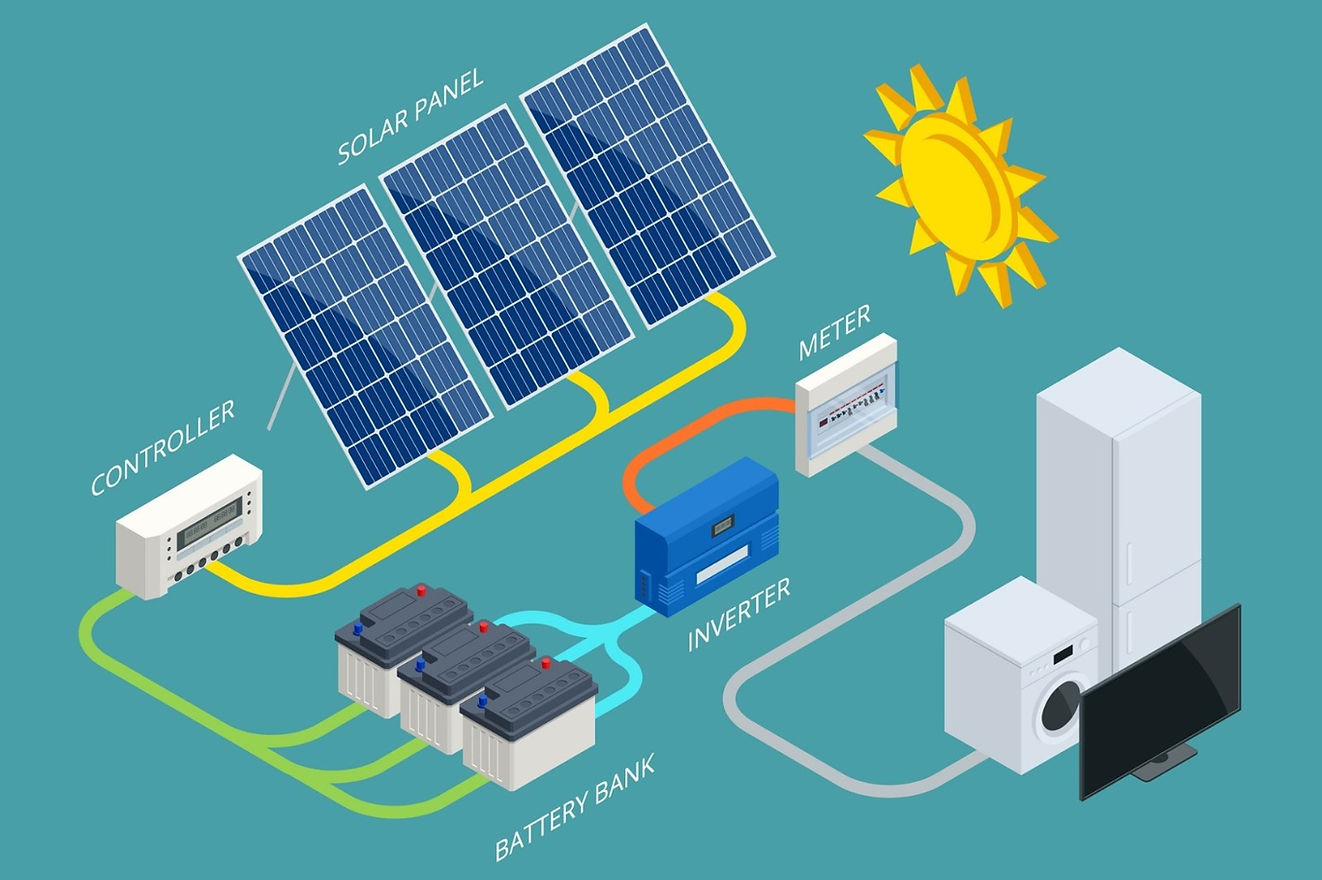
An inverter converts DC to alternating current (AC) for the home. Excess electricity can go back to the grid through net metering, if available, or charge a battery.
Efficiency
Commercial panels convert about 15% to 23% of sunlight into electricity. The best laboratory cells exceed 40% with multijunction designs. Perovskite silicon tandem cells have reached over 33% in the lab.
Output
A typical residential panel produces 350 to 450 watts. A typical US home uses about 10,500 kilowatt hours per year and needs around 20 to 25 panels, depending on sunlight.
Degradation
Panels lose about 0.5% of output per year. Warranties generally guarantee 80% to 90% of rated power after 25 years.

Cost
The average residential system cost in the US was about 2.80 to 3.50 dollars per watt in recent years. The federal Residential Clean Energy Credit provided a 30% tax credit as of 2024.
Global capacity
The world surpassed 1,400 gigawatts of installed solar capacity in 2023, according to the International Energy Agency. Solar was the fastest growing energy source.
Emissions
Lifecycle emissions are about 40 grams of CO2 equivalent per kilowatt hour, similar to or lower than natural gas.
Concentrated solar
Mirrors focus sunlight to heat a fluid, which makes steam to drive a turbine.
Storage
Batteries store daytime energy for use at night.
Photovoltaic effect and efficiency
Solar panels convert light into electricity through the photovoltaic effect, discovered by Edmond Becquerel in 1839. When photons strike silicon cells, they knock electrons loose, creating direct current, which an inverter converts to alternating current for home use. Typical commercial panels are 18 to 23 percent efficient, and the best lab cells exceed 26 percent for silicon. Panels degrade about 0.5 percent per year and are often warrantied for 25 years. A typical 6 kilowatt home system may generate roughly 8,000 kWh a year depending on location.

Cost, capacity and emissions
Residential solar costs about 3 USD per watt before incentives in the US in recent years, and federal tax credit rules were changed by 2025 legislation, so check current incentives before buying. Global installed solar capacity surpassed 1,400 gigawatts by the end of 2023, according to the International Renewable Energy Agency. Lifecycle emissions for solar are around 40 to 50 grams of CO2 per kilowatt hour, according to the IPCC, much lower than coal at around 820. Batteries can store extra power for evenings. Concentrated solar power uses mirrors to heat fluid and drive turbines.
Based on data from the International Renewable Energy Agency and the IPCC