Sunlight helps your body make vitamin D and can lift mood and regulate sleep. Limit exposure to avoid sunburn and skin damage.
Benefits
- Vitamin D: skin makes it when exposed to UVB. Needed for bones and immunity.
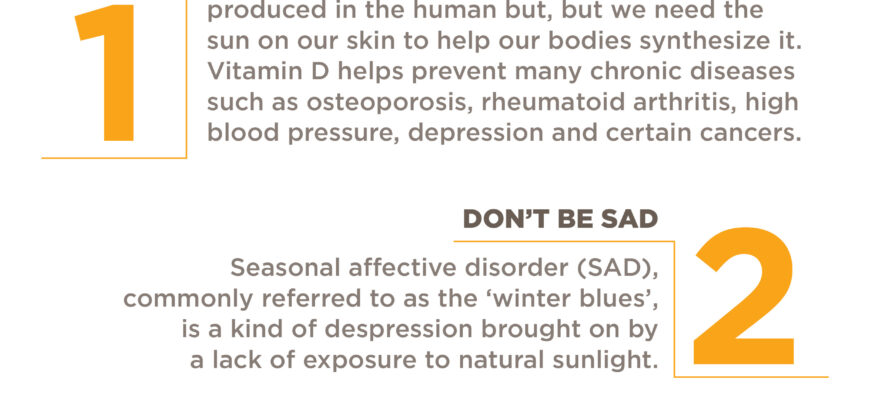
- Mood: sunlight raises serotonin and helps with seasonal depression.
- Sleep: morning light sets the circadian rhythm.
How much
Around 10 to 30 minutes of midday sun a few times a week for light-skinned people, and longer for darker skin, can help, depending on location and season.
Risks
Sunburn, skin aging and skin cancer. The American Academy of Dermatology says the safest way to get vitamin D is through food or supplements.
Protection
Use SPF 30, hats and shade.

Winter
In northern latitudes, UVB is too weak for vitamin D production from November to February.
Benefits in detail
- Vitamin D: skin makes vitamin D when exposed to UVB light. About 10 to 30 minutes of midday sun a few times a week gives enough vitamin D for many fair skinned people, while darker skin needs longer.
- Mood: sunlight raises serotonin levels and helps regulate the circadian rhythm. Light therapy with 10,000 lux for 20 to 30 minutes is a recognized treatment for seasonal affective disorder.
- Sleep: morning light helps set the body clock and improves sleep quality.
- Bone health: vitamin D helps absorb calcium. Deficiency causes rickets in children and osteomalacia in adults.
- Possible blood pressure benefits: nitric oxide released in skin by UV exposure may lower blood pressure, according to a small study.
- Some skin conditions such as psoriasis improve with controlled UV exposure.
How much

There is no single amount for everyone. It depends on skin tone, latitude, season, time of day and how much skin is exposed. A common suggestion is about 5 to 30 minutes of midday sun on arms and legs, twice a week, for light skin. The Institute of Medicine recommends 600 IU of vitamin D daily for adults up to age 70 and 800 IU for those over 70, from food, supplements or sun. About 35% of US adults are vitamin D insufficient, according to some surveys.
Risks
Too much sun causes sunburn, premature skin aging, eye damage, including cataracts, and skin cancer. One in five Americans develops skin cancer in their lifetime. The WHO classifies UV radiation as a carcinogen. Five or more sunburns double the risk of melanoma.
Protection
- Avoid peak sun between 10 a.m. and 4 p.m. when UV is strongest.
- Use broad spectrum SPF 30 or higher sunscreen when outdoors for long periods.
- Wear a hat and sunglasses.
- Check the UV index. At 3 and above, protection is advised.
- Do not use tanning beds.
Winter
At latitudes above about 35 degrees north, the sun in winter is too low for the skin to make much vitamin D from November to February. Eating fatty fish, fortified milk and eggs, or taking a supplement can help. Spend time outdoors for mood and light, even on cloudy days, when light outside is still much brighter than indoors.

Vitamin D and how skin makes it
Skin makes vitamin D when ultraviolet B rays (wavelengths 290 to 315 nm) convert 7-dehydrocholesterol into previtamin D3. In summer, about 10 to 30 minutes of midday sun on bare arms and legs several times a week is often cited as enough for fair skinned people, while darker skin needs longer because melanin blocks UVB. Above roughly 37 degrees latitude, which includes Boston, Denver and Madrid, the winter sun is too low for meaningful vitamin D production from about November to March. Sunscreen with SPF 30 blocks about 97 percent of UVB, but typical application is thin, so real world vitamin D production often continues. About 35 percent of US adults have vitamin D levels below 20 ng/mL, according to some national surveys. Sun is also linked to better mood and sleep timing through light exposure to the eyes in the morning.
Based on data from the NIH Office of Dietary Supplements and the American Academy of Dermatology