
A democracy is rule by the people, while a republic is a system where elected representatives govern under a constitution. The US is both a democracy and a republic.
Democracy
A democracy is rule by the people. In a direct democracy, citizens vote on laws. In a representative democracy, they elect officials.
Republic
A republic is a state where the head of state is not a monarch and power comes from citizens through elected representatives governed by law. The US Constitution guarantees each state a “republican form of government” (Article IV).
Overlap
The US is both a democratic republic. Most modern democracies are republics, though some, like the UK, are constitutional monarchies.
Key difference
Republics stress rule of law and limits on majority power. Pure democracy stresses majority rule.
Origin

Latin res publica means “public thing”.
Examples
France, India and the US are republics.
Democracy in detail
A democracy is a form of government in which power rests with the people, who rule either directly or through elected representatives. The word comes from the Greek demos (people) and kratos (rule). Ancient Athens, around 508 BCE, had a direct democracy where male citizens voted on laws. Modern democracies typically use representative systems with free elections.
Republic in detail
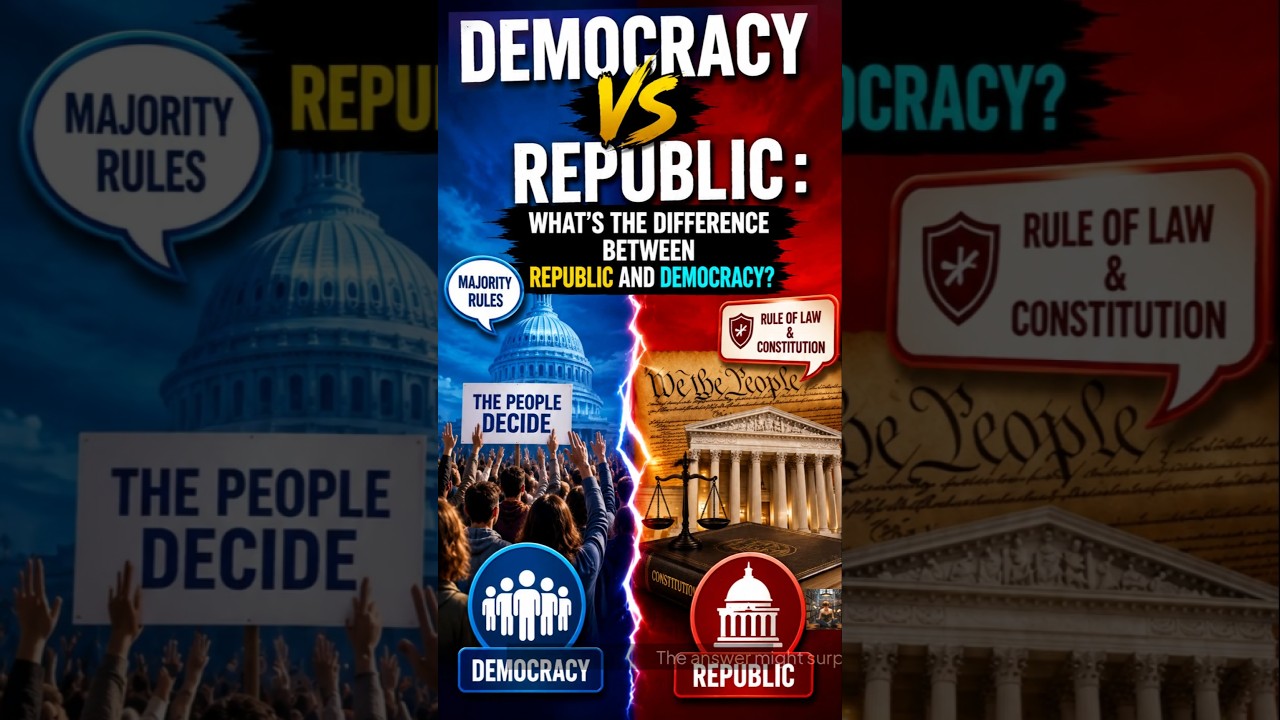
A republic is a state without a monarch, where the head of state is not a hereditary ruler. The word comes from the Latin res publica, meaning “public affair.” The government is based on law, often a constitution, with elected officials who represent the citizens and limits on power to protect minority rights. The Roman Republic lasted from 509 BCE to 27 BCE.
Overlap
Most modern states are both. The US is a constitutional federal republic with democratic elections. The two terms describe different things: democracy describes who holds power (the people), and republic describes the structure (no monarch, rule of law, elected leaders). France, India, Germany, Brazil and Mexico are democratic republics. Not all republics are democratic, such as one-party states like China (officially the People’s Republic), and not all democracies are republics, such as constitutional monarchies like the United Kingdom, Canada, Japan and Sweden.
Key difference
The classic distinction is between pure or direct democracy, where the majority decides directly and can override individual rights, and a republic, where elected representatives govern under a constitution that protects rights. James Madison discussed this in Federalist No. 10 (1787), arguing that a republic would guard against the dangers of majority factions. In everyday use today, “democracy” often means “liberal democracy,” which includes republican features.
Origin
The framers of the US Constitution chose a republic and were wary of pure democracy. The Pledge of Allegiance refers to “the republic for which it stands.” Guarantee Clause (Article IV, Section 4) promises each state a “Republican Form of Government.”
Examples
- Direct democracy: Swiss cantons like Appenzell, which still hold open-air assemblies, and referendums.
- Representative democracy and republic: the US, France, India.
- Constitutional monarchy with democracy: the United Kingdom, Norway.
- Autocratic republics: North Korea (officially the Democratic People’s Republic of Korea).

Constitutional examples
A democracy is a system where power rests with the people, who govern directly or through elected representatives. A republic is a state where the head of state is not a monarch and officials are chosen by or answer to the people, usually under a constitution that limits majority power. The US is a constitutional federal republic and also a representative democracy. Founders such as James Madison in Federalist No. 10 favored a republic to guard against the “tyranny of the majority.” Pure direct democracy is rare today, though Switzerland uses frequent referendums. Countries such as France, India and Germany are republics, while the United Kingdom, Japan and Canada are constitutional monarchies that are also democracies. The Roman Republic, founded around 509 BC, is a historical example. The terms overlap, and many modern states are both.
Based on data from the National Archives and the Encyclopaedia Britannica




