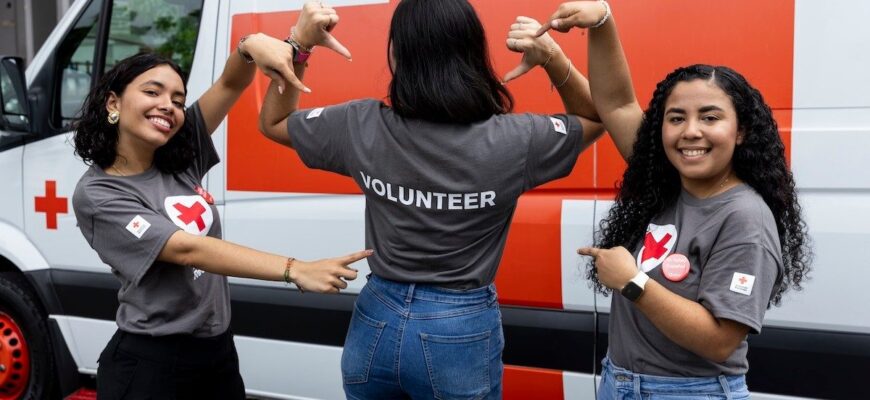
You can volunteer by searching for local opportunities on sites like VolunteerMatch or by contacting charities, food banks, shelters, or schools near you.
Where to find opportunities
- VolunteerMatch.org, Idealist.org and Points of Light.
- Local food banks, shelters, libraries and hospitals.
- Habitat for Humanity, Red Cross, schools and animal shelters.
- AmeriCorps (full-time service).
How to start
- Pick a cause you care about.
- Check time and skills needed.
- Contact the organization and apply. Some require background checks or training.
Benefits
Volunteering is linked to better mental health and sense of purpose.
Numbers
About 28 percent of Americans volunteered formally in 2021 (AmeriCorps).
Tip
Start with a one-time event.

Remote
Many groups offer virtual volunteering.
Skills based volunteering
Skilled roles use professional skills such as accounting, web design, legal help, teaching or translation. Many nonprofits value these because the same service would otherwise cost hundreds of dollars per hour.
Time commitment
- One time events: park cleanups, food drives, disaster response.
- Regular shifts: a few hours per week at a food bank, hospital or library.
- Long term: mentoring, board service or tutoring over a school year.
Age and background rules

- Many organizations allow volunteers from age 14 or 16, and some programs accept younger children with a parent.
- Roles with children, older adults or patients usually require a background check and sometimes training or a health screening.
Official volunteer programs
- AmeriCorps places members in 1,000s of programs for service terms of several months to a year, with a living allowance and an education award.
- Peace Corps sends volunteers abroad for 27 months, including training, with housing and a stipend.
- Disaster agencies like the Red Cross train volunteers before deployment.
Virtual volunteering
Remote roles include crisis text counseling, tutoring, translation, transcription of historical documents and citizen science projects such as classifying images online.
Tax note
Volunteer time is not tax deductible. Unreimbursed out of pocket costs, such as mileage at the charitable rate, may be deductible if you itemize and the organization is a qualified charity.
Verify the organization
Search the IRS Tax Exempt Organization Search to confirm status, and check ratings on sites like Charity Navigator.
Matching your skills to a need
Many nonprofits need professional skills such as accounting, web design, legal help, translation, grant writing and marketing, often called skills based volunteering. Taproot Foundation and similar groups connect professionals with nonprofits for projects of a few weeks to several months. Hands on roles include food banks, shelters, habitat building, tutoring, park cleanups and animal shelters. Hospitals and hospices usually require an application, a health screening and training of about 8 to 20 hours. AmeriCorps and the Peace Corps are structured service programs with stipends or living allowances, with commitments of 10 months to 2 years.

Practical points before you commit
Check minimum ages, which are often 14 to 16 for hospital and shelter roles, and expect background checks for work with children or vulnerable adults. Ask for a role description and a time commitment. The IRS lets you deduct unreimbursed out of pocket costs for a qualified charity, including mileage at 14 cents per mile for charitable use of a car, but the value of your time is not deductible. Verify that a charity is legitimate in the IRS Tax Exempt Organization Search or on Charity Navigator before giving money or personal information. Volunteer.gov, VolunteerMatch and Idealist list opportunities by location and cause.
Based on data from AmeriCorps and the IRS




