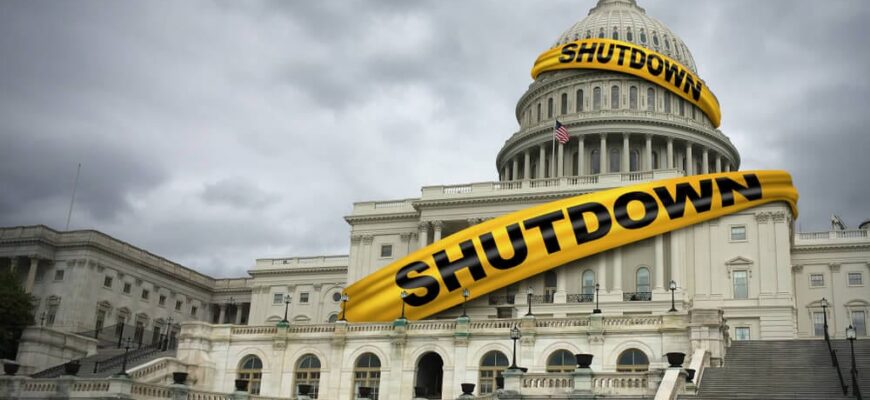
In a US government shutdown, nonessential federal employees are furloughed and some services pause, while essential work and programs like Social Security payments continue.
What happens
A shutdown occurs when Congress doesn’t pass funding bills by the deadline (October 1). Under the Antideficiency Act, agencies must stop nonessential work.
Employees
Nonessential federal employees are furloughed, and essential workers (military, air traffic control, TSA, law enforcement) work, often without pay until funding resumes. The 2018 to 2019 shutdown lasted 35 days, the longest on record.
Services
- Social Security and Medicare payments continue.
- National parks may close or reduce services.
- Passport and some agency services may be delayed.
- USPS continues (self-funded).
Back pay
The Government Employee Fair Treatment Act of 2019 guarantees back pay for furloughed employees.

Ends
When Congress passes a funding bill or continuing resolution.
What happens
A US federal government shutdown occurs when Congress does not pass funding bills or a continuing resolution by the end of the fiscal year on September 30, and the president does not sign them. Under the Antideficiency Act, agencies may not spend money without appropriations. Operations that are not essential stop until funding resumes. There have been 22 funding gaps since 1976, with 10 involving furloughs.
Employees
Federal workers are put into two groups. Essential employees, such as air traffic controllers, TSA officers, military personnel, border patrol and law enforcement, work without pay until the shutdown ends. Non-essential employees are furloughed and sent home without pay. In the 2018 to 2019 shutdown, about 800,000 workers were affected, and about 380,000 were furloughed.

Services
- Social Security and Medicare checks continue, as these are funded by permanent mandatory programs, though some services such as new card issuance may slow.
- The Postal Service continues, since it is self-funded.
- National parks may close or have limited services.
- Passport and visa processing continues in many cases because fees fund it, though some offices close.
- The IRS may slow customer service. Tax refunds were delayed in some past shutdowns.
- Food assistance (SNAP) and WIC can be disrupted if funds run out.
- Federal courts keep operating for a few weeks using fee balances.
- Small business loans and mortgage approvals through federal agencies can be delayed.
Back pay
The Government Employee Fair Treatment Act of 2019 guarantees back pay for federal employees after a shutdown, including those who were furloughed. Contractors are not guaranteed back pay, which affects many workers.
Cost
The longest shutdown lasted 35 days, from December 22, 2018 to January 25, 2019. The Congressional Budget Office estimated that it cost the economy about $11 billion, of which $3 billion was permanently lost.
How it ends
Congress passes and the president signs a spending bill or continuing resolution. Negotiations often involve disputes over budgets, policy riders or debt. Shutdowns end when enough votes are found in both chambers.

Historical record
The longest US federal shutdown lasted 35 days from December 22, 2018 to January 25, 2019, over border wall funding. A shutdown in October to November 2025 lasted 43 days and became the longest on record. Shutdowns happen when Congress fails to pass appropriations bills or a continuing resolution by the start of the fiscal year on October 1. About 800,000 federal employees were furloughed or worked without pay during the 2018 to 2019 shutdown. Essential services such as the military, air traffic control, border protection, and Social Security payments continue, but many national parks, passport processing and some inspections are limited. Federal employees received back pay under the Government Employee Fair Treatment Act of 2019. The Congressional Budget Office estimated that the 2018 to 2019 shutdown reduced GDP by a permanent 3 billion USD.
Based on data from the Congressional Budget Office and the Congressional Research Service