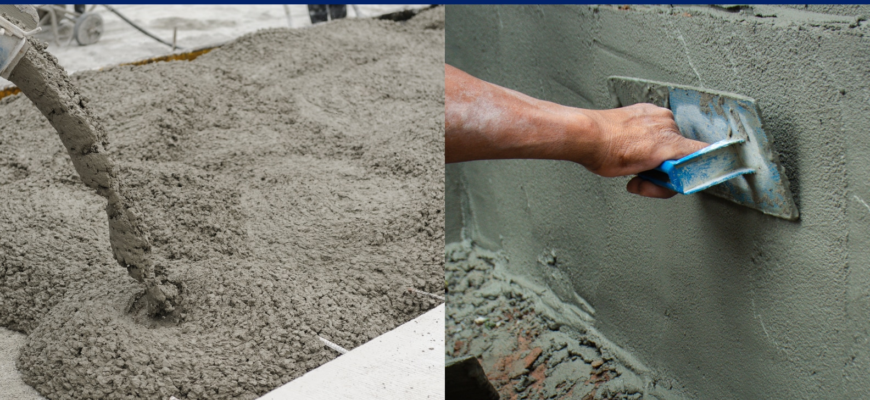
Cement is an ingredient in concrete. Concrete is a mix of cement, water, sand, and gravel.
Cement
A fine gray powder, made of heated limestone and clay. It is the binder.
Concrete
A mix of cement (10% to 15%), water, sand and gravel. It hardens into a strong material.
Mortar
A mix of cement, sand and water, used between bricks.
Common mistake
A sidewalk is concrete, not cement.
Strength
Concrete reaches most of its strength in 28 days.
What is in each
Cement is a fine powder made by heating limestone and clay in a kiln at about 1,450 degrees C to form clinker, then grinding it with gypsum. Concrete is a mix of cement (10% to 15%), water (15% to 20%), sand and gravel or crushed stone (60% to 75%).

How it hardens
When water is added, cement reacts in a process called hydration, forming crystals that bind aggregates. Concrete gains most of its strength within 28 days, though it keeps gaining strength for months.
Common types of cement
Ordinary Portland cement is the most widely used, patented in 1824 by Joseph Aspdin in England. Other types include rapid hardening, sulfate resistant and white cement.
Strength
Common residential concrete has a compressive strength of 2,500 to 4,000 psi. Higher strength concrete for structures can exceed 10,000 psi.
Reinforcement

Concrete is strong in compression but weak in tension, so steel rebar or mesh is added to form reinforced concrete.
Curing
Keep concrete moist for at least 7 days after pouring to prevent cracking and boost strength.
Mortar and grout
Mortar is cement mixed with sand and water, used to bond bricks. Grout is a thin mixture to fill gaps between tiles.
Environmental impact
Cement production accounts for around 8% of global CO2 emissions, according to Chatham House, due to burning fuel and the chemical reaction of limestone.
World use
The world produces more than 4 billion tons of cement per year. Concrete is the most used human made material, second only to water as a consumed resource.
Common error
People often say “cement sidewalk” when the sidewalk is concrete.
Composition and strength
Cement is a fine powder, usually Portland cement, made by heating limestone and clay in a kiln at about 1,450 C, which acts as the binder. Concrete is a mix of cement (about 10 to 15 percent), water, sand and gravel or crushed stone, so cement is an ingredient in concrete, not the same material. Mixed with water, cement undergoes hydration and hardens, reaching most of its strength in 28 days. Concrete has high compressive strength, often 3,000 to 5,000 psi for residential work, but low tensile strength, so steel reinforcement (rebar) is added. Mortar is a mix of cement, sand and water used to bind bricks, and grout fills gaps.

History and environmental impact
Joseph Aspdin patented Portland cement in England in 1824. Concrete is the most widely used human made material, with an estimated 30 billion tonnes produced each year. Cement production accounts for roughly 8 percent of global carbon dioxide emissions, according to a Chatham House report, because of both fuel use and the chemical release of CO2 from limestone. Cures take time, so keeping concrete moist for several days improves strength. Ancient Romans used volcanic ash based concrete that has lasted two thousand years in structures like the Pantheon.
Based on data from the Portland Cement Association and Chatham House