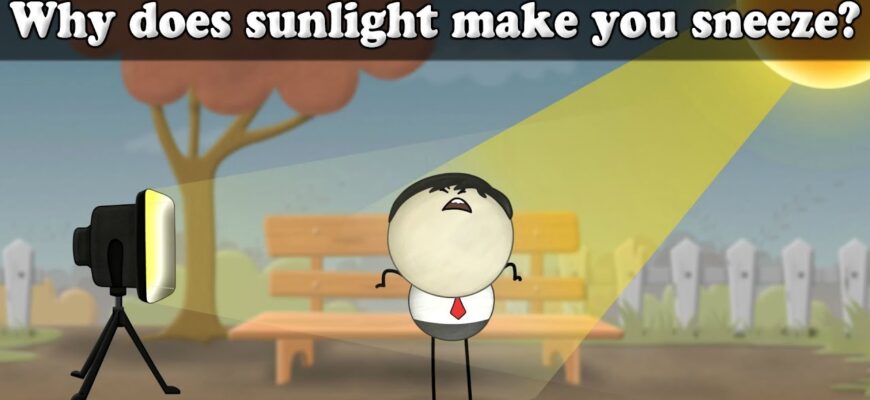
Sneezing at bright light is called the photic sneeze reflex, and it is a harmless inherited trait.
Name
Photic sneeze reflex, also known as ACHOO syndrome (autosomal dominant compelling helio-ophthalmic outburst).
How common
It affects about 18% to 35% of people.
Cause
Likely crossed signals between the optic nerve and the trigeminal nerve, which controls sneezing. It is inherited.
Is it harmful
No. It is harmless.
Tips
Wear sunglasses.
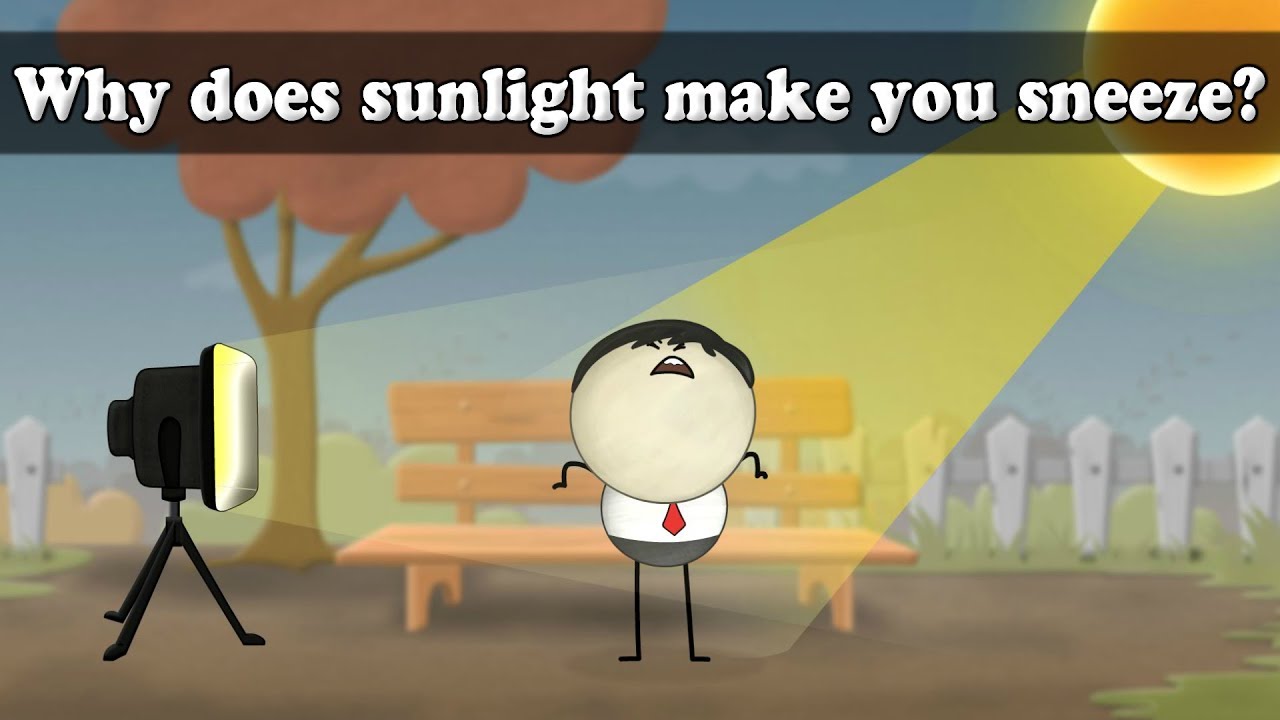
Photic sneeze reflex
Sneezing when looking at bright light is called the photic sneeze reflex, also known as ACHOO syndrome (Autosomal dominant Compelling Helio-Ophthalmic Outburst). It is genetic and inherited as a dominant trait, so a child has a 50% chance of inheriting it from an affected parent.
Prevalence
Studies estimate that 18% to 35% of people have it. It was described by Aristotle, who thought the heat of the Sun caused the sneeze.
Cause theory
Bright light causes the pupils to constrict, and the optic nerve signals cross with the trigeminal nerve, which senses irritation in the nose. The brain interprets the signal as an itch in the nose and triggers a sneeze. This is called crossed wires, and the exact mechanism is still unknown.
Pattern
Often people sneeze 2 or 3 times in a row. Sneezing can follow going from a dark room to bright sunlight, or looking at a camera flash.
Is it harmful
It is generally harmless. However, it can be dangerous in specific situations, such as driving, flying or doing tasks with precision, because sneezing makes you close your eyes briefly. One study of fighter pilots noted this risk.
Tips
- Wear sunglasses or a hat with a brim when going outdoors.
- Close your eyes and look away when going from dark to bright light.
- Pressing on the bridge of the nose or the roof of the mouth may stop a sneeze.
Other triggers
Some people sneeze after eating a large meal or when plucking eyebrows.
See a doctor
Usually no treatment is needed. See an eye doctor if bright light causes pain or other symptoms.
Genetics and mechanism
The photic sneeze reflex, nicknamed ACHOO syndrome (autosomal dominant compelling helio ophthalmic outburst), makes about 18 to 35 percent of people sneeze when exposed to bright light, such as stepping outside. It is inherited in an autosomal dominant pattern, so a child of an affected parent has a 50 percent chance of having it. One theory says that the optic nerve, activated by bright light, triggers a nearby trigeminal nerve branch that handles nasal sensation, causing a crossed signal and a sneeze. People often sneeze two or three times in a row.
Safety and tips
The reflex is harmless but can be dangerous when driving out of a tunnel, as sneezing with eyes closed is a hazard. Sunglasses and a hat brim lower the trigger. Some people also sneeze after plucking eyebrows or eating a large meal. See a doctor if sneezing comes with itchy eyes, congestion and other allergy symptoms, since that suggests allergic rhinitis, which affects about 25 million US adults.
Based on data from the National Library of Medicine and the American Academy of Allergy, Asthma and Immunology