Jumping rope burns about 10 to 15 calories per minute, depending on your weight and intensity.
Estimate
Jumping rope burns about 10 to 15 calories per minute at a moderate pace. For a 155 lb person, it’s about 12 per minute (Harvard Health), or 720 calories per hour.
By weight
- 125 lb: about 10 calories/min.
- 155 lb: about 12.
- 185 lb: about 14.
Compared
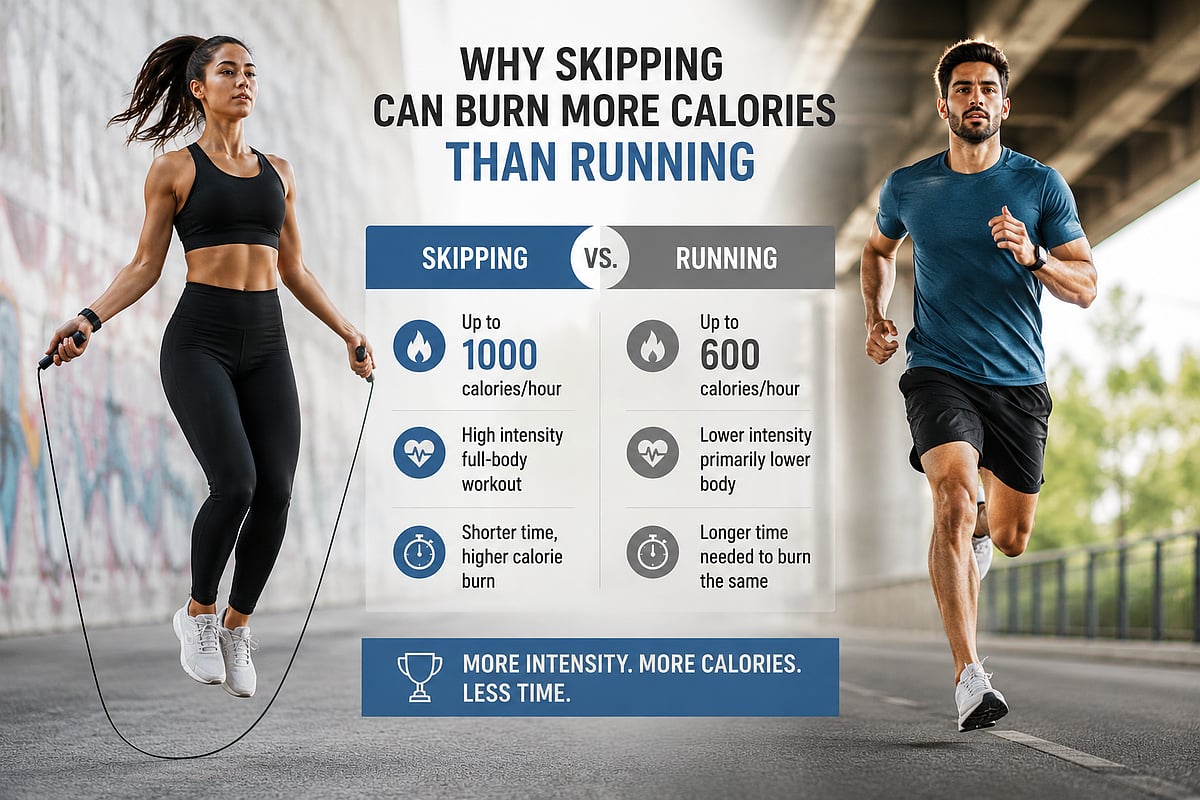
Jumping rope burns about the same as running at 6 mph.
Intensity
Faster speeds and double unders burn more.
Benefits
Cardio, coordination and bone density.
Tips
Start with 10 to 15 minutes, use a soft surface, wear supportive shoes and keep jumps low.
Caution
Can strain calves, shins and joints.
Rope length
The handles should reach your armpits when standing on the rope.
Estimate
Jumping rope burns about 10 to 16 calories per minute for most adults, or about 600 to 1,000 calories per hour at a moderate to vigorous pace. A 150-pound person burns around 12 calories a minute, or 360 calories in 30 minutes at about 100 to 120 skips per minute. The calculation uses the MET value, a measure of exercise intensity: slow jump rope has a MET of about 8.8 and fast jump rope about 12.3 (Compendium of Physical Activities).
By weight
Estimated calories burned in 10 minutes of moderate jumping at 100 skips per minute:

- 125 pounds: about 100 calories.
- 155 pounds: about 125 calories.
- 185 pounds: about 150 calories.
Calories scale with body weight and speed. Fast pace roughly 130 or more skips per minute burns more.
Compared
A 2007 American Council on Exercise study cited by various fitness sources said that 10 minutes of jumping rope is roughly equal to running an 8-minute mile for 30 minutes, though this claim is based on a 1970s study and results depend on pace. Running at 6 mph burns about 11 calories per minute for a 150-pound person, so jumping rope is similar.
Intensity
Skipping at 120 to 140 revolutions per minute is vigorous. Beginners usually can only keep going for 1 to 3 minutes before resting. Use intervals of 30 seconds on and 30 seconds off. Double unders and high knees raise the intensity.
Benefits
- Cardiovascular fitness and heart health.
- Bone density, thanks to the impact.
- Coordination, agility and balance.
- Calf and shoulder endurance.
- Efficient, as it takes little space and equipment, which costs $10 to $20.
Tips
- Choose the correct rope: with the handles reaching armpit height when stepping on the center.
- Jump on a wood floor, rubber mat or gym floor, and not on concrete.
- Land softly on the balls of the feet with small jumps.
- Wear supportive athletic shoes.
- Warm up for 5 minutes.
Caution
Jumping rope is high impact. People with knee, ankle or back problems, osteoporosis, or those who are pregnant or very overweight should check with a doctor or choose lower impact exercise. Stop if you feel pain.
Rope length
Stand on the middle of the rope; the handles should reach your armpits. A person 5 feet 7 inches to 5 feet 11 inches tall commonly uses a 9-foot rope.

MET values and calorie calculation
Jump rope is rated at about 11.8 METs for moderate speed (100 skips a minute) and 12.3 METs for fast speeds, according to the Compendium of Physical Activities. Calories burned per minute equal METs times body weight in kilograms times 3.5 divided by 200. A 70 kg (154 pound) person skipping at a moderate pace burns roughly 14 calories a minute, or about 145 calories in 10 minutes, and a 90 kg person burns about 18 per minute. A 125 pound person burns about 11 to 12 calories per minute. Jumping rope for 10 minutes has been compared in older studies to about 30 minutes of jogging, but this depends on pace. It builds bone density, coordination and cardiovascular fitness. Choose a rope that reaches your armpits when you stand on its center. Land softly on the balls of the feet, keep jumps low and use a cushioned surface to reduce shin and knee strain.
Based on data from the Compendium of Physical Activities and the American Council on Exercise