Conflict diamonds, or blood diamonds, are mined in war zones and sold to fund armed conflict. The Kimberley Process was created to limit their trade.
Definition
Conflict diamonds, or blood diamonds, are rough diamonds mined in war zones and sold to finance armed conflict against governments. The term arose in the 1990s with wars in Sierra Leone, Angola and the Democratic Republic of the Congo.
Kimberley Process
Created in 2003 by the UN. It requires participating countries to certify rough diamonds as conflict-free. It has 85 participants covering most of world production.
Criticism
The definition covers only rebel groups, not human rights abuses by governments, and enforcement is weak.
Share
The industry says over 99 percent of diamonds are conflict-free.
Buying

Ask for a Kimberley Process certificate, buy lab-grown or recycled diamonds, or buy from certified sellers.
Film
The 2006 movie Blood Diamond brought attention.
How conflict diamonds were funded
Conflict diamonds were mined in war zones and sold to pay for armed conflict against recognized governments. The term became widely known during the civil wars in Sierra Leone (1991 to 2002), Angola (1975 to 2002) and Liberia, and during the war in the Democratic Republic of the Congo. In Sierra Leone, the Revolutionary United Front used diamond revenue to buy weapons, and its fighters became known for mutilating civilians. The United Nations estimated that the wars in Angola, Sierra Leone and Liberia together killed hundreds of thousands of people and displaced millions.
Why diamonds are easy to smuggle

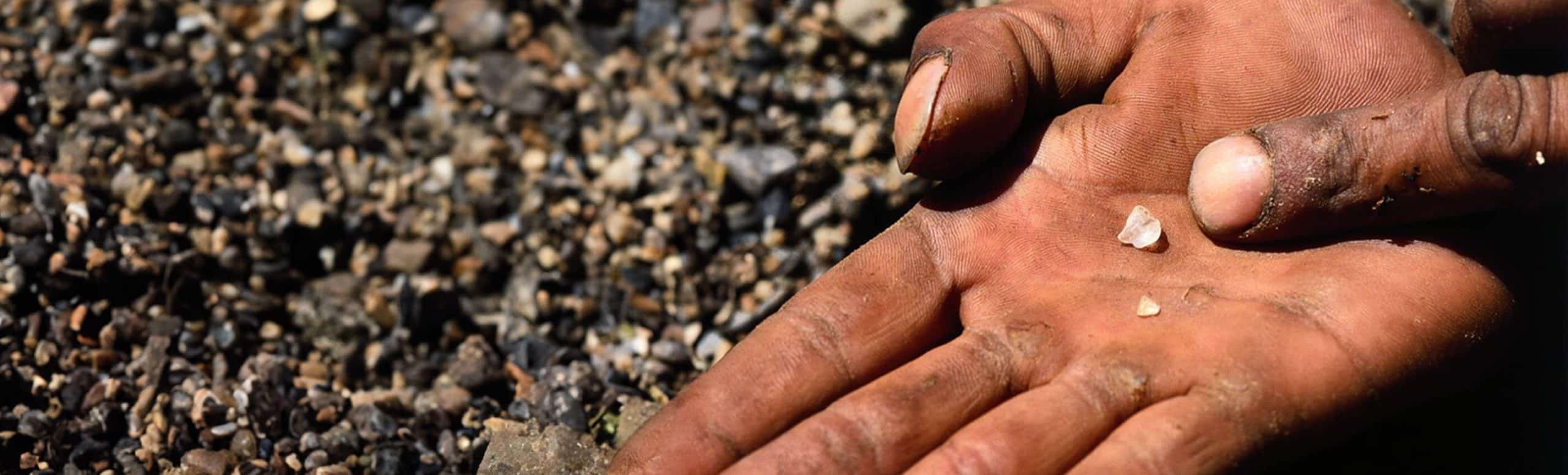
Rough diamonds are small, valuable, easy to hide and hard to trace. A stone mined by rebels can be carried across a border, mixed with legitimate stones in a trading center such as Antwerp, and cut and polished with no visible record of its origin. Diamonds carry no mark from the mine, so buyers cannot tell a conflict stone from a clean one by looking at it. Alluvial diamonds, found in riverbeds and shallow gravel, are the hardest to control because thousands of informal diggers work them with simple tools.
The Kimberley Process in detail
The Kimberley Process Certification Scheme began in 2003 after talks in Kimberley, South Africa, in 2000. Participating countries must certify that rough diamond shipments are conflict free and ship them in tamper-resistant containers with a numbered certificate. About 85 countries take part, covering the great majority of world production and trade. The scheme defines conflict diamonds narrowly, as rough diamonds used by rebel movements to finance war against legitimate governments. Decisions need consensus among members, which makes reform slow.
Why critics say the system falls short
Global Witness left the scheme in 2011, arguing that it ignores violence by governments and security forces, forced labor and other human rights abuses. Partnership Africa Canada, another founding civil society member, withdrew in 2017 for similar reasons. Diamonds from Zimbabwe’s Marange fields were allowed back onto the market after army abuses in 2008, a decision critics saw as a failure. The Central African Republic had its exports suspended in 2013 during its civil war, and a partial easing followed later.
Numbers on the trade
Industry groups say that more than 99% of diamonds today are conflict free, a figure quoted since the early 2000s. Before the scheme, conflict diamonds were estimated at roughly 4% of the world trade by value in the late 1990s. Global rough diamond production is around 110 to 130 million carats a year, with Russia, Botswana, Canada, Angola and the DRC among the top producers. Human rights groups argue the 99% figure only counts a narrow definition of conflict.
Sanctions and policy
The UN Security Council imposed diamond sanctions on UNITA in Angola in 1998, on Sierra Leone’s rebels in 2000 and on Liberia in 2001. These sanctions pushed countries toward the Kimberley Process. In the US, the Clean Diamond Trade Act of 2003 requires that imported rough diamonds come with Kimberley certificates. In 2022 the US and several allies banned Russian rough diamonds from the leading producer Alrosa, adding a different ethical debate about where stones come from.
What buyers can do
- Ask the seller for a written warranty that the diamond is conflict free and for the stone’s origin.
- Choose diamonds with documented provenance, such as stones with a traceable chain recorded on a tracking system.
- Consider recycled or antique diamonds, which reuse stones already in circulation.
- Consider lab-grown diamonds, which are chemically and physically the same as mined diamonds and have no mining link. They usually cost 60% to 80% less than mined stones of the same quality.
Based on data from the Kimberley Process, the United Nations, Global Witness and the US Department of the Treasury.