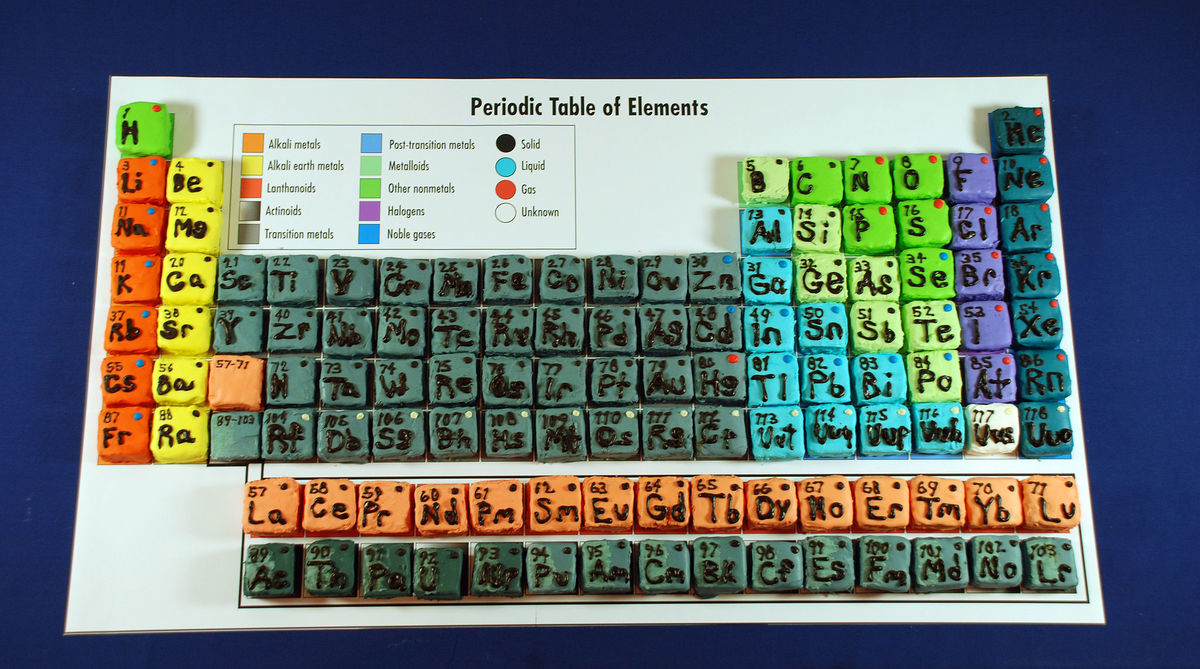
The periodic table has 18 groups, which are the vertical columns, such as alkali metals (group 1), halogens (group 17), and noble gases (group 18).
Layout
The periodic table has 18 groups (vertical columns) and 7 periods (rows).
Main groups
- Group 1: alkali metals (Li, Na, K).
- Group 2: alkaline earth metals (Mg, Ca).
- Groups 3 to 12: transition metals.
- Group 13: boron group.
- Group 14: carbon group.
- Group 15: nitrogen group (pnictogens).
- Group 16: chalcogens (oxygen group).
- Group 17: halogens (F, Cl, Br).
- Group 18: noble gases (He, Ne, Ar).
Why groups matter
Elements in a group have the same number of valence electrons, so they react in similar ways.
Standard
IUPAC numbering from 1 to 18.
History of the table
Dmitri Mendeleev published his periodic table in 1869 and arranged elements by atomic weight, leaving gaps for elements not yet found. He predicted properties of gallium, scandium and germanium, and their later discovery supported his table. In 1913 Henry Moseley showed that atomic number, not weight, is the correct ordering principle, which fixed a few mismatches in the older version.
The main groups in detail
- Group 1, alkali metals (lithium, sodium, potassium, rubidium, cesium, francium): soft, shiny metals with one outer electron. They react vigorously with water, and the reaction grows stronger down the group.
- Group 2, alkaline earth metals (beryllium, magnesium, calcium, strontium, barium, radium): two outer electrons, harder and less reactive than group 1.
- Groups 3 to 12, transition metals: metals such as iron, copper, gold and zinc, often forming colored compounds and several oxidation states.
- Group 17, halogens (fluorine, chlorine, bromine, iodine, astatine, tennessine): seven outer electrons, highly reactive nonmetals that form salts with metals.
- Group 18, noble gases (helium, neon, argon, krypton, xenon, radon, oganesson): full outer shells, so they rarely react.
Periods and blocks

The seven periods are the rows. Period 1 has only hydrogen and helium, periods 2 and 3 have eight elements each, and periods 4 and 5 have 18. Periods 6 and 7 have 32 elements when the lanthanides and actinides are included. The table is also split into s, p, d and f blocks, named after the type of orbital that fills last. Block f holds the two rows normally shown below the main table.
Trends across the table
Atomic radius generally shrinks across a period from left to right and grows down a group. Electronegativity, the pull on shared electrons, rises toward the top right and peaks at fluorine (3.98 on the Pauling scale). Ionization energy follows a similar pattern, which explains why helium is the hardest element to ionize. These trends let chemists predict how a new element will behave from its position.
Metals, nonmetals and metalloids
Most of the 118 known elements are metals. About 17 are nonmetals, such as carbon, oxygen and the halogens. Metalloids, including boron, silicon, germanium, arsenic, antimony and tellurium, sit along a staircase line and have mixed properties. Silicon’s semiconducting behavior is why it underpins the chip industry.
Group numbering systems
Groups are numbered 1 to 18 in the modern IUPAC system. Older US books used labels such as IA, IIA and VIIIA, while European books used a different A and B pattern. This can cause confusion when reading older sources. The 1 to 18 system is the standard in textbooks and exams today.

Recent additions
The last four elements, nihonium (113), moscovium (115), tennessine (117) and oganesson (118), were named in 2016, completing the seventh period. Elements above 100 are synthetic, made in particle accelerators in tiny amounts, and last from fractions of a second to minutes.
Based on data from IUPAC, the Royal Society of Chemistry and Britannica.